

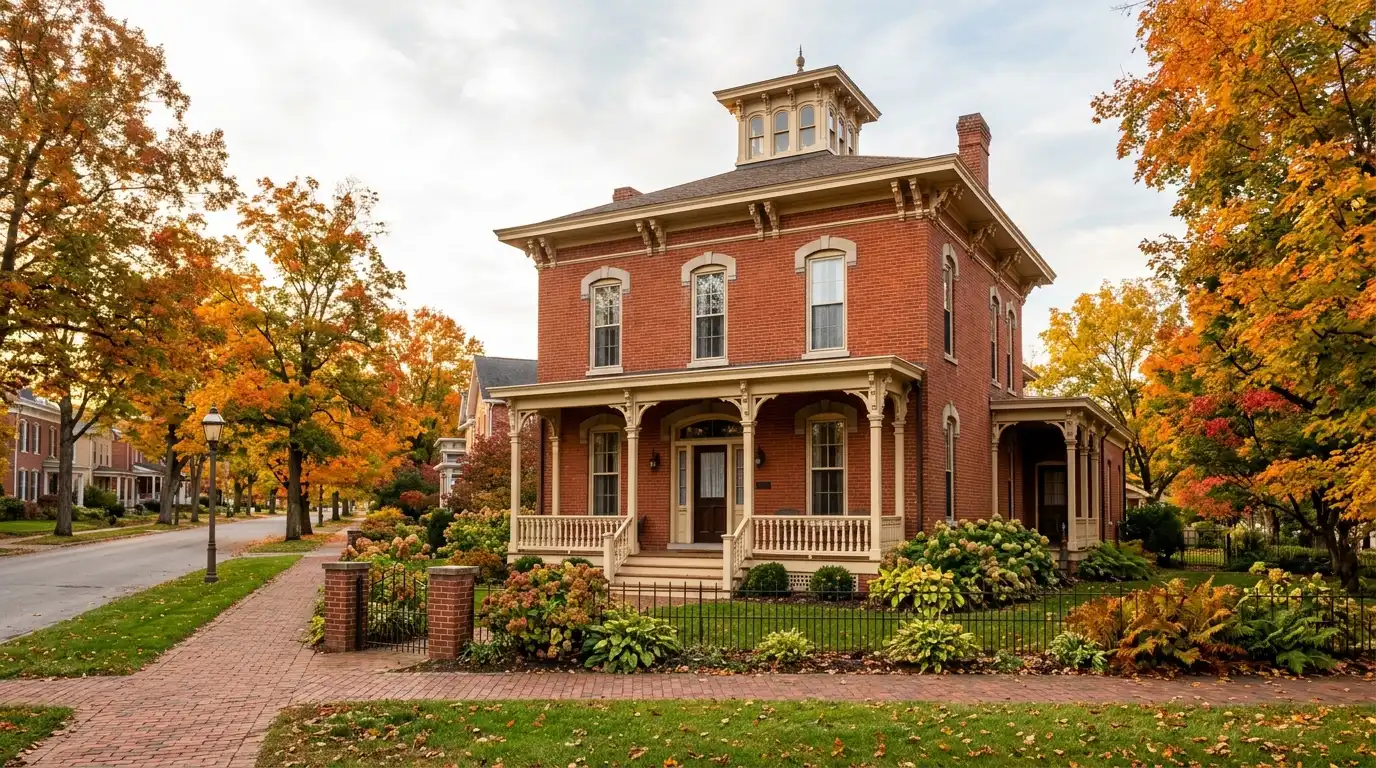
The right Noblesville realtor reads the parcel, not the ZIP code: its taxing district, whether it runs on city sewer or a septic system and well, whether downtown demolition review reaches it, and what the seller’s disclosure form leaves out. Since January 2021, Steve Clark’s Compass profile lists 40 closed sales with a Noblesville address, 14 as the listing agent.
No agent is the right choice for every buyer or seller. What you can test is whether an agent knows the rules that change what a specific Noblesville home is worth to you. Below are those rules, from Indiana law and City and County records, the questions that expose an agent who does not know them, and our record.
Who is the best realtor in Noblesville, Indiana?
The one who can answer parcel questions on the spot and show recent Noblesville closings you can confirm. Noblesville is the Hamilton County seat, chosen in 1824, and a second class city since January 1, 2016. The city spans four townships, four taxing districts carry its levy, and two school corporations levy inside its limits, so an agent who answers from the mailing address will get part of it wrong.
Our guide to living in Noblesville walks through those districts, the school corporation split and why a Noblesville 46060 address can sit outside the city. One figure belongs here: district 013 Noblesville City, the Noblesville Township part of the city, carries a certified gross rate of 2.5549 per $100 of assessed value for taxes payable 2026, down from 2.6804, before deductions, credits and the circuit breaker caps. This is general information, not tax or legal advice; confirm the district and rate for a specific parcel with the Hamilton County Auditor.
What does an Indiana seller have to disclose, and what does the form leave out?
A seller of a home with one to four units must complete and sign Indiana’s disclosure form and give it to the buyer before an offer is accepted (IC 32-21-5-10). The form records what the seller actually knows about the property’s condition. It is not a warranty, and the statute says it cannot stand in for an inspection.
The Indiana Real Estate Commission adopts the form under IC 32-21-5-7: State Form 46234, the Seller’s Residential Real Estate Sales Disclosure. The seller marks each system defective, not defective, not applicable or unknown, and answers other questions yes, no or unknown. Six parts carry extra weight in Noblesville.
| Part of the form | What the seller answers | Why it matters here |
|---|---|---|
| Water and sewer system | The condition of any septic field or bed, septic mound, aerator system, well or cistern; whether the home connects to public water and public sewer | The answer tells you which inspections to order |
| Additions and the sewage system | Whether any addition may require improvements to the sewage disposal system, and whether they were completed | Adding a bedroom on a septic lot needs a County construction permit |
| Hazardous conditions | Known conditions such as radon gas in the house or well, methane gas, lead paint, mold or asbestos insulation | The form asks about radon in well water as well as the house |
| Historic district | Whether the property is in a locally designated historic district under IC 36-7-11 | Older homes near the courthouse square raise the question; see the historic section below |
| Permits | Whether substantial additions or alterations were made without a required building permit | Ask for the permit history before you rely on a finished basement or an addition |
| Flood | Whether any part of the property is in a FEMA flood plain, and whether the owner pays flood insurance | The City, the State and the federal government issued emergency declarations after the August 2026 flooding |
Sources: Indiana Real Estate Commission, Seller’s Residential Real Estate Sales Disclosure, State Form 46234, from the State Forms site; Indiana Code 2026, IC 32-21-5-7. Retrieved November 7, 2026.
When does the seller have to hand it over, and what if it comes late?
Before an offer is accepted. Until the owner and the buyer have both signed the form, an accepted offer is not enforceable against the buyer before closing (IC 32-21-5-10(c)). If a buyer receives the form, or an amended form, after acceptance and it discloses a defect, the buyer may nullify the contract within two business days by delivering a written rescission to the owner or the owner’s agent, and is entitled to the return of any deposits (IC 32-21-5-13). At or before settlement, the seller must disclose any material change in the property’s physical condition or certify that its condition is substantially the same (IC 32-21-5-12).
What does the form not promise?
Three limits matter. The form is not a warranty by the owner or the owner’s agent and may not be used as a substitute for inspections (IC 32-21-5-9). The owner is not liable for an error outside the owner’s actual knowledge, or one taken from a public agency’s or licensed professional’s report the owner reasonably believed, and in either case only if the owner was not negligent in getting and passing on third-party information (IC 32-21-5-11). And a seller may answer “unknown” where the information is unknown or unavailable (IC 32-21-5-12). An “unknown” beside the septic system or the well is your cue to inspect, not a reassurance.
Which sales come with no disclosure form at all?
The statute exempts several transfers (IC 32-21-5-1), among them court-ordered transfers such as estate administration, foreclosure sales and divorce decrees; transfers by a fiduciary administering an estate or trust; and the first sale of a dwelling that has never been inhabited. That last exemption covers a builder’s new home. On an exempt sale, plan your inspections as if no form exists, because none will.
The seller’s form is a different document from the sales disclosure form that buyer and seller file with the county auditor; our Carmel agent guide explains that one. This section is general information, not legal advice. Read the form and your purchase agreement themselves, and ask an Indiana real estate attorney about your own situation.
What should a Noblesville seller gather before listing?
The form’s instructions tell the seller to complete it personally, answer every question truthfully and report all known conditions. A listing agent cannot answer for you, but can help you assemble the records that turn an “unknown” into a documented answer: the County’s septic and well permit records, a recent well water test, building permits for additions, pumping receipts and the parcel’s FEMA flood zone.
How do you check a Noblesville home on a septic system and a private well?
Start with the County’s records, then order your own septic inspection and water test inside the inspection period, because state law bars any requirement for a septic inspection at sale, and the County’s well program asks for sampling when a well is drilled or repaired, not when a home sells. Whether a Noblesville-addressed home is on sewer is a parcel fact: the City’s Noblesville Utilities provides wastewater service, Hamilton Southeastern Utilities, Inc., a private sewer utility, serves portions of the city in Wayne Township, and a 46060 mailing address can sit outside the city entirely.
Indiana law bars the state, counties, cities and other local units from requiring a residential septic system to be inspected or tested in connection with a sale, or before a deed is recorded (IC 32-21-5.2-8; the only exception is part of St. Joseph County). A Hamilton County septic system can change hands with no inspection at all. If the seller’s form says septic, or says “unknown”, write a septic inspection into the offer’s inspection period and pull the County’s permit record before that period ends.
Who regulates septic systems in Hamilton County?
The Hamilton County Health Department. Indiana’s residential onsite sewage rule, 410 IAC 6-8.3, is administered locally through the county health officer (410 IAC 6-8.3-51), and the County’s On-Site Sewage Disposal Program conducts site evaluations, issues permits and performs inspections. A written construction permit is required before a septic system is added to, altered, replaced or repaired, and before a home is expanded or remodeled in a way that may increase its bedrooms (410 IAC 6-8.3-53). The County’s permit procedure puts it plainly: “The addition of extra bedroom(s) is new construction.”
That rule catches buyers. A listing that counts a finished basement bedroom on a septic lot raises a question for the County’s permit file: was the system permitted for that bedroom count? If not, the cost of bringing it into line belongs in the negotiation, not in your first year of ownership.
What should a buyer pull and test on a septic and well property?
| Check | Where it comes from | What it tells you |
|---|---|---|
| Septic permit record | Hamilton County Health Department public records search, septic permits | When the system was permitted and for what, and any repair permits since |
| Septic inspection | An inspector you hire, inside your inspection period | The system’s current condition; no public body may require one at sale |
| Well permit record | Hamilton County Health Department public records search, well permits | The County requires a permit for every well drilled or repaired |
| Well log | Indiana DNR Water Well Record Database | The State’s record of the well, searchable by street address and ZIP code in the DNR’s viewer |
| Water test | A state-certified drinking water laboratory | Bacteria, nitrate and nitrite, arsenic, lead and copper |
| Separation distance | 410 IAC 6-8.3-57, measured on site | Septic tank and absorption field at least 50 feet from a private water supply well |
Sources: Hamilton County Health Department, On-Site Sewage Disposal Program, Well Water Supply Program and public records search; Indiana DNR Division of Water, Water Well Record Database; Indiana Department of Health, Well Water Quality and Testing; 410 IAC 6-8.3. Retrieved November 7, 2026.
The County recommends a septic inspection at least every three years and says most tanks need pumping every three to five years, depending on use, so ask the seller for pumping and service receipts. For the well, the Indiana Department of Health recommends testing at least once a year and notes that private well water is unregulated by both the Indiana Department of Environmental Management and the Environmental Protection Agency, which leaves it to the owner. It also notes that glacial deposits of arsenic exist throughout Indiana and that a well may need sanitizing after flooding. A licensed home inspection is a separate check; our Fishers agent guide covers what Indiana’s inspection standard includes and how to ask for a radon test.
Could the City require the home to connect to sewer?
Possibly, if a sewer is close. Indiana law lets a city that operates its own sewage works require a property to connect and stop using a septic tank, but only when an available sanitary sewer is within 300 feet of the property line and the owner gets at least 90 days’ notice by certified mail (IC 36-9-23-30). A separate section exempts some property outside the city’s boundaries whose septic system meets its conditions (IC 36-9-23-30.1). Noblesville runs its own wastewater utility, and two more Noblesville annexation ordinances were recorded in 2026, so ask the seller in writing whether a connection notice has arrived, and ask the utility whether a sewer main runs within 300 feet.
What changes near Morse Reservoir?
Citizens Energy Group owns Morse Reservoir, and its Drought Management Plan says Morse and Geist “were constructed as water supply reservoirs.” Indiana’s septic rule keeps a residential system at least 200 feet from a public water supply lake or reservoir; a system with secondary treatment that meets the rule’s conditions may sit closer, but no closer than 50 feet (410 IAC 6-8.3-57). If you are buying near the shoreline on septic, ask the Health Department which setback applies before you plan a repair or an addition. Citizens’ shoreline rules, covered in our Fishers agent guide, apply at Morse as at Geist.
Does Noblesville have a historic district that limits what you can do to an older home?
Not in the way most buyers assume. Downtown Noblesville and the blocks around it have districts listed in the National Register of Historic Places, but federal listing places no restrictions on what a private owner does with a property. The City rule that does bind older buildings downtown is demolition review in its Downtown Protection Area, and the City’s Spring 2024 zoning map shows no historic preservation overlay district.
Is National Register listing the same as local review?
No. The National Park Service states that “Under Federal Law, the listing of a property in the National Register places no restrictions on what a non-federal owner may do with their property up to and including destruction, unless the property is involved in a project that receives Federal assistance.” The Conner Street Historic District, east of the downtown commercial area, was listed in 1999, according to the Indiana Historical Bureau’s state marker. Listing records historic character; it does not, by itself, require anyone’s approval to change a building.
Local review is a different instrument. Under IC 36-7-11, a city may create a historic preservation commission by ordinance, and once its legislative body approves a district map, a certificate of appropriateness is required before a permit issues for demolition, moving a building, a conspicuous exterior change or new construction visible from a public way (IC 36-7-11-4, -7 and -10). That is the district the seller disclosure form asks about.
What review applies in Noblesville today?
The City’s list of boards and commissions, as of October 2026, includes no historic preservation commission. Its Unified Development Ordinance provides for a Historic Preservation (HP) Overlay District, which the Common Council may designate on the Plan Commission’s recommendation after a study of the area, or must consider on a petition from more than half of the owners in it; inside one, new construction, additions and alterations go through site plan review. The City’s Spring 2024 zoning map shows no HP overlay. And the City’s Downtown Design Guidelines of February 2008, written for its Façade Improvement Grant Program, state that “the guidelines are not mandatory.”
What does bind is demolition review. Under the Unified Development Ordinance (Article 4, Part F, Section 4, effective May 24, 2022), demolishing any structure larger than 400 square feet inside the Downtown Protection Area requires a Certificate of Authorization from the Plan Commission, after a public hearing, and Common Council approval before the Planning Department may issue a demolition permit.
- Where: the Downtown Protection Area mapped in Appendix I of the ordinance, bounded roughly by Harrison Street on the north, Division Street on the south, the White River and 6th and 7th Streets on the west, and 11th Street and the alley between 10th and 11th Streets on the east. The ordinance’s street-by-street description controls.
- What the Plan Commission weighs: whether the structure is an imminent threat to the public, whether demolition serves a greater public purpose, whether the building is a historic landmark or contributes to a historic district, and whether the new construction fits the area’s established or intended character.
- Delay: if rehabilitation or restoration is feasible and the structure is not an imminent threat, a citizen or community group may request a 90-day hold to look for alternatives. If none is found by the end of the hold, the Plan Commission issues the certificate.
- Facades: in a highlighted part of the area, demolition is allowed only if the facades cannot be kept, the damage cannot be repaired in a fiscally reasonable way, and the new building uses styles and elements recorded in the district’s National Register application. For a structure the ordinance marks non-contributing, only that last condition applies.
- Exemption: a demolition tied to a project with an executed Economic Development Agreement resolution is exempt, though the same factors are considered.
If your plan for a downtown property includes taking down a house, garage or other structure over 400 square feet, price in a public hearing, a Council vote and a possible 90-day hold. The City launched All In Noblesville on June 2, 2026 to rewrite its plan and its 1996 Unified Development Ordinance over about 18 to 24 months, so ask the Planning Department in writing what applies to the parcel when you write the offer.
What should you ask a Noblesville realtor before you hire?
Ask questions only someone who has worked Noblesville parcels can answer without looking them up. A ready answer names the record, the rule or the office to call.
| Ask | A ready answer includes |
|---|---|
| Which taxing district and school corporation is this address in? | The state taxing district, such as 013, 019, 021 or 022 inside the city, confirmed with the Hamilton County Auditor, and the corporation that levies there |
| Is it on City sewer, Hamilton Southeastern Utilities, Inc. or a septic system? | The provider on the seller’s bill, or the County’s septic permit record |
| If it is on septic, how many bedrooms was the system permitted for? | The County permit file, compared with the bedrooms in the listing |
| If it has a well, when was the water last tested, and for what? | A dated report from a state-certified laboratory, or a plan to test inside the inspection period |
| Is a sewer main within 300 feet? | An answer from the utility, and whether the seller has received a connection notice under IC 36-9-23-30 |
| Is this building in the Downtown Protection Area? | The ordinance’s Appendix I map and a written answer from the Planning Department |
| What did the seller mark unknown on the disclosure form? | A specific inspection, record or written question for each one |
| How many Noblesville closings have you had since 2024, and on which side? | Addresses you can confirm, with dates and the side represented |
Sources: Indiana Code 2026, IC 32-21-5 and IC 36-9-23-30; 410 IAC 6-8.3; City of Noblesville Unified Development Ordinance, Article 4 and Appendix I; Hamilton County Health Department. Retrieved November 7, 2026.
If you are buying, the written buyer agreement you sign before touring is explained in our Westfield agent guide. Agreements and agency are legal questions: this is general information, not legal advice, so read each agreement before you sign it and ask an Indiana real estate attorney about your own situation.
How do you check a Noblesville agent’s license and record?
Look the agent up on the Indiana Professional Licensing Agency’s license search at mylicense.in.gov, then ask for closed Noblesville sales with dates and the side represented, and confirm them. Our Carmel agent guide covers both checks in depth.
What is our record in Noblesville, and who would you work with?
| Measure | Value |
|---|---|
| Closed sales with a Noblesville address | 40 |
| Of those, as the listing agent | 14 |
| Closed in 2024 or later | 23 |
| Sold between $300,000 and $499,999 | 24 |
| Median price of the 40 sales | $414,850 |
Source: closed sales listed on Steve Clark’s Compass agent profile, January 1, 2021 through October 23, 2026, read November 7, 2026. Counts are sales where he is named as listing or buyer’s agent, by the city in the sale’s postal address.
These are Steve Clark’s own sales, counted by postal address, so an address in the count can sit outside the city limits. Steve Clark, Broker, founded the team in 2016, and our office is at Compass, 10 E. Main Street, Suite 250, in Carmel. The team includes Angelo Caruso, Associate Broker, Lead Buyer Agent; Lauren Giesler, Associate Broker; Jeff Rossier, Director of Operations; Beth Givan, Director of Client Experience; Jackie Miller, Client Liaison; and Samantha Losier, Transaction Coordinator.
What should you be able to state before you sign with a Noblesville agent?
Before you sign a buyer agreement or a listing agreement in Noblesville, you, or the agent you are interviewing, should be able to state each item below for the address you care about. If the agent cannot, keep interviewing.
The parcel’s taxing district and school corporation from the county record; whether it is on City sewer, Hamilton Southeastern Utilities, Inc. or a septic system, and if septic, the bedroom count on its County permit; whether it has a well, with a dated water test; whether a sewer main runs within 300 feet; whether it lies in the Downtown Protection Area; its FEMA flood zone; and, if you are selling, which of your disclosure answers rest on a record rather than memory.
An agent who answers those questions with a permit number, a map or a section of the ordinance has worked here. One who answers with reassurance has not, and every unanswered item stays your risk.
Frequently Asked Questions
Who is the best realtor in Noblesville, Indiana?
No single agent is right for every buyer or seller. The right Noblesville realtor can tell you a parcel’s taxing district, whether it is on sewer or a septic system and well, whether the City’s downtown demolition review reaches it and what Indiana’s seller disclosure form leaves out, and can show recent Noblesville closings you can confirm.
What should I ask a Noblesville realtor before hiring one?
Ask which taxing district the address is in, whether it is on City sewer, Hamilton Southeastern Utilities, Inc. or septic, how many bedrooms a septic system was permitted for, when a well was last tested, whether the building is in the Downtown Protection Area, and how many Noblesville closings the agent has had since 2024.
When does an Indiana seller have to give the buyer a disclosure form?
Before an offer is accepted. Unless the sale is exempt under IC 32-21-5-1, such as a court-ordered sale or the first sale of a never-inhabited home, IC 32-21-5-10 requires the owner of a home with one to four units to complete, sign and give the buyer a seller’s disclosure form first. If a buyer gets the form after acceptance and it discloses a defect, the buyer may nullify the contract within two business days and recover deposits (IC 32-21-5-13).
Is Indiana’s seller disclosure form a warranty?
No. IC 32-21-5-9 says the form is not a warranty by the owner or the owner’s agent and may not be used as a substitute for inspections. It reports what the seller actually knows, and the seller may answer unknown. Order your own inspections.
Does Indiana require a septic inspection when a house is sold?
No, and it may not. IC 32-21-5.2-8 bars the state and local governments from requiring a residential septic system to be inspected or tested in connection with a sale or before a deed is recorded, except in part of St. Joseph County. A buyer of a Noblesville-area home on septic has to write the inspection into the offer.
How do I find out whether a Noblesville home is on septic or a well?
Read the seller’s disclosure form, which asks about septic fields, mounds and wells and whether the home connects to public water and sewer, then search the Hamilton County Health Department’s public records for septic and well permits. The Indiana DNR’s Water Well Record Database can be searched by street address and ZIP code.
How often should a private well be tested in Indiana?
At least once a year, the Indiana Department of Health recommends, through a state-certified drinking water laboratory. Private well water is unregulated by IDEM and the EPA, so the owner is responsible for it. In Hamilton County every well drilled or repaired must be permitted by the County Health Department.
Does Noblesville have a historic district that restricts renovations?
Not a local one on the City’s Spring 2024 zoning map. Downtown has National Register districts, but federal listing places no restrictions on a private owner unless a federally assisted project is involved, and the City’s ordinance allows a Historic Preservation Overlay District that the Spring 2024 map does not show. What the City does review is demolition of structures over 400 square feet in its Downtown Protection Area.
Can you tear down an older house in downtown Noblesville?
Only with approval if it is over 400 square feet and inside the Downtown Protection Area. Noblesville’s Unified Development Ordinance requires a Certificate of Authorization from the Plan Commission after a public hearing, then Common Council approval, before a demolition permit issues. If rehabilitation or restoration is feasible and the structure is not an imminent threat, a citizen or community group may request a 90-day hold to look for alternatives. Projects with an executed Economic Development Agreement resolution are exempt.
How many Noblesville sales has Steve Clark closed since 2021?
Since January 2021, Steve Clark’s Compass profile lists 40 closed sales with a Noblesville address through October 23, 2026, 14 of them as the listing agent. The median price of those 40 sales is $414,850, and 23 closed in 2024 or later. Counts are by the city in each sale’s postal address.
Keep reading
- Noblesville, Indiana
- Living in Noblesville, Indiana: one city, two school corporations
- Fishers vs Noblesville: how the two cities compare
- Indiana homestead deduction: how to file after you buy
- Selling your home with our team
- Best Realtor in Fishers, Indiana: A Buyer and Seller Guide (2026)
- Best Realtor in Indianapolis: Choosing an Agent for the North Side (2026)
- Meet the team
Talk through a Noblesville home before you sign
Tell us the address and whether you are buying or selling. The first conversation covers the septic, well, permit and downtown review questions above, what the disclosure form will need to show, and how we would price the home or shape an offer on it.
Start the conversation