

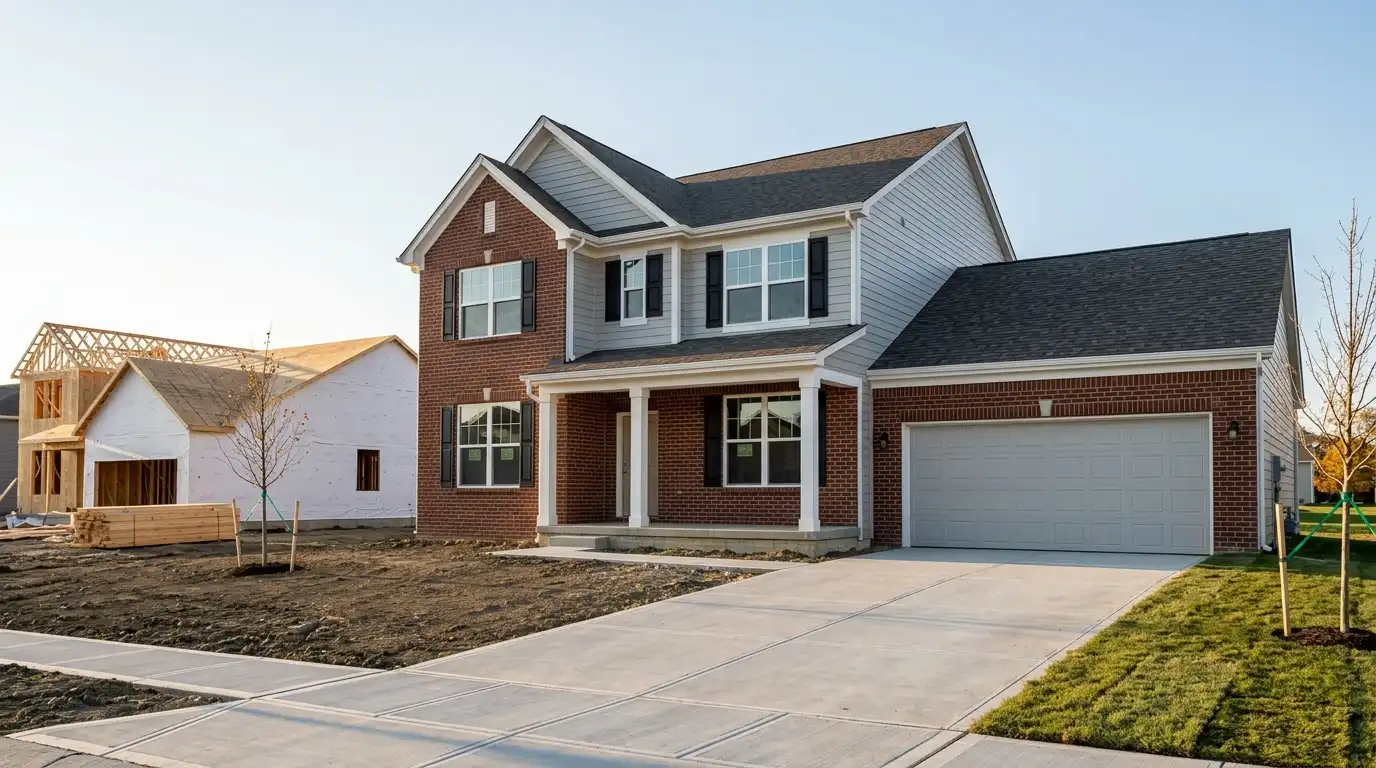
Indiana does not automatically give a new home buyer a warranty. Under Indiana Code 32-27-2-8(a) a builder “may warrant” the two, two, four and ten year periods most buyers assume state law guarantees, so the first thing to settle in a builder contract is not the price but whether those warranties appear in the written agreement at all. Almost everything else a builder will and will not move on follows from that one word.
Our team works Hamilton County and Boone County from our Carmel office at Compass Indiana LLC: Carmel, Zionsville, Westfield, Fishers, Noblesville, Whitestown and Lebanon. What follows is what the Indiana statutes say and what we ask for in writing. It describes the rules. It is not legal or tax advice.
Before you rely on any of this
Statutes are cited so you can read them yourself. Applying them to your contract is legal work. Have a licensed Indiana attorney review the purchase agreement and any warranty document before you sign, ask a licensed Indiana tax professional about your own position, and ask the Hamilton County or Boone County Assessor about your specific parcel.
Does Indiana law automatically give you a warranty on a new home?
No. The governing chapter is Indiana Code 32-27-2, titled New Home Construction Warranties, and its operative sentence is permissive. IC 32-27-2-8(a) says that in selling a completed new home, and in contracting to sell a new home to be completed, “the builder may warrant to the initial home buyer” the periods below. Not shall. The remedy section is built the same way: IC 32-27-2-10(a) gives a buyer a cause of action only “if a builder provides and breaches” one of them. A builder who provides none has not broken the statute.
That one word moves the whole negotiation. These periods circulate as though Indiana confers them on every new home in the state. They are a framework a builder may adopt. So the useful question at a model home is whether a warranty is in the written contract, whether it tracks this framework or a shorter one of the builder’s own, and what the contract asks you to surrender in return.
| Period | What the statute describes | Citation |
|---|---|---|
| 2 years | The new home will be free from defects caused by faulty workmanship or defective materials. | IC 32-27-2-8(a)(1) |
| 2 years | Free from defects caused by faulty installation of plumbing, electrical, heating, cooling or ventilating systems, exclusive of fixtures, appliances or items of equipment. | IC 32-27-2-8(a)(2) |
| 4 years | Free from defects caused by faulty workmanship or defective materials in the roof or roof systems. | IC 32-27-2-8(a)(3) |
| 10 years | Free from major structural defects. | IC 32-27-2-8(a)(4) |
Source: Indiana Code 32-27-2-8(a), Indiana General Assembly, 2026 edition of the Indiana Code, text confirmed identical to the 2025 edition. Section last amended by P.L.137-2023, SEC.9. Retrieved August 17, 2026. Each period begins on the warranty date defined at IC 32-27-2-7. The section reads “may warrant,” and IC 32-27-2-10(a) applies only where a builder “provides and breaches” one of these warranties.
What does “major structural defect” actually mean?
It is a defined term, narrower than the plain words suggest. IC 32-27-2-3 defines it as actual damage to the load bearing part of a new home or model home, including actual damage due to subsidence, expansion or lateral movement of the soil affecting the load bearing function, unless that soil movement is caused by flood, earthquake or some other natural disaster. The definition of the home is narrow too. IC 32-27-2-4(b) says “new home” does not include a detached garage, driveway, walkway, patio, boundary wall, a retaining wall not necessary for structural stability, landscaping, a fence, nonpermanent construction material, an off-site improvement, an appurtenant recreational facility, other similar item, or a model home. Where the driveway and the retaining walls are a real part of what you are paying for, those items sit outside the chapter and have to be handled in the contract.
When does the warranty clock start?
Not necessarily at your closing. IC 32-27-2-7 defines the warranty date for a new home as the date of first occupancy as a residence by any of five people: the builder, someone renting from the builder, someone living in the home at the builder’s request, the initial home buyer, or someone renting from the initial home buyer. On an inventory home that has already been lived in, the clock can be running before you sign. The statute anticipates that. IC 32-27-2-8(c) requires a seller who is the builder, a renter from the builder, or an individual living in the home at the builder’s request to notify the purchaser in writing, on or before closing, of the warranty date and the time remaining under the warranty. If that notice is missing, ask for it in writing and ask why.
Model homes run on a separate track. Under IC 32-27-2-8.5(a) the builder may warrant only that a model home will be free from major structural defects for ten years beginning on the warranty date. There is no two or four year set. IC 32-27-2-7(2) sets that date as the day the home was first used as a model home, typically well before it is offered for sale, and IC 32-27-2-8.5(c) passes the written notice duty to whoever buys it and later resells. IC 32-27-2-3.5 defines a model home as a new dwelling first used as a model, a sales office, a design center, or any combination.
What is the builder asking for in exchange?
In Indiana the statutory warranties are usually the consideration for something the buyer gives up, and that half gets left out. IC 32-27-2-9(a) lets a builder disclaim all implied warranties only if three conditions are met: the warranties defined in the chapter are expressly provided for in the written contract, performance of the warranty obligations is backed by an insurance policy at least equal to the purchase price, and the builder carries completed operations products liability insurance covering reasonably foreseeable consequential damages. IC 32-27-2-9(b) then requires the disclaimer in a minimum size of 10 point boldface type, acknowledged by complete signature, plus a separate one page notice attached to the contract headed “NOTICE OF WAIVER OF IMPLIED WARRANTIES.” IC 32-27-2-9(c) adds that if either policy defaults, the disclaimer is void from and after the default.
If you are handed that one page notice
The statutory language says you are giving up claims for implied warranties, “which may be greater than the express warranties.” You are trading unwritten protections that Indiana courts define case by case for a written set with fixed periods and an insurance backstop. That trade can be reasonable. It is not automatic, and the statute conditions it on insurance that has to actually exist. Ask for evidence of both policies, and have an Indiana attorney read the disclaimer and the notice before you sign either.
Two provisions matter before you negotiate anything else. IC 32-27-2-11(a) says the chapter’s warranties are in addition to any rights created by contract, so the two stack rather than replace each other. And IC 32-27-2-10(b) caps a damages award at actual damages, either the cost to repair the defect or the difference in value with and without it, plus reasonably foreseeable consequential damages, plus attorney’s fees only if those fees are provided for in the written contract between the parties. That last clause is a drafting decision, not a fact of law. It costs nothing at the sales table and is worth a great deal three years later.
What will a builder negotiate, and what will it usually not?
Base price is defended hardest, and the reason is structural rather than stubborn. A recorded discount on one home becomes a comparable sale for every remaining home in the community and follows it into appraisals for months. Incentives, allowances and credits do not reset the recorded price, which is why concessions in a builder transaction usually arrive as something other than a lower number on the first page.
Be clear about the limits of that observation. No public source publishes builder concession rates by community, and MIBOR does not report incentives. The table below is our own description of where movement is and is not usually available. Treat it as experience, not as a measured figure.
| Term | Where movement is usually hard | Where movement is usually available |
|---|---|---|
| Base price of the home | Protects the community’s comparable sales and future appraisals | Rarely, and usually only on standing inventory |
| Incentives and design allowances | Commonly, because they do not reset the recorded price | |
| Closing cost credits | Often conditioned on an affiliated lender or title company | Commonly, subject to that condition |
| Lot premium | Held with the lot inventory | Occasionally on remaining lots |
| Structural options after the cutoff | Framing, foundation and roof line decisions close early and stay closed | Before the cutoff, not after |
| Contingency on selling your current home | Usually refused on a to be built home | Sometimes on standing inventory |
| Warranty terms in the written contract | Yes, and this is where we spend leverage | |
| Attorney’s fees clause | Yes, and IC 32-27-2-10(b)(3) makes it matter | |
| Inspection access during construction | Yes, if written in rather than requested later | |
| Written change orders and a delay remedy | Yes, and both are cheap to add at signing |
Practitioner description of our own transactions in Hamilton and Boone counties, August 2026. No public data source publishes builder concession rates or incentive values, and MIBOR reports neither. This table is not a measured figure and should not be read as one. Statutory citation in the attorney’s fees row: Indiana Code 32-27-2-10(b)(3).
One number a sales office quotes that is not theirs to guarantee is your property tax. Indiana’s assessment date is January 1, and it sets the values for taxes due and payable in the following calendar year under IC 6-1.1-2-1.5, so an estimate built on a vacant lot or a partially complete house will not be the bill you eventually pay on a finished one. Ask a licensed Indiana tax professional about your own position and the county assessor about your own parcel.
Why does buyer representation still matter at a model home?
Because Indiana sets the default in the opposite direction from what most buyers assume. IC 25-34.1-10-9.5(a) provides that a licensee “has an agency relationship with, and is representing, the individual with whom the licensee is working” unless there is a written agreement to the contrary or the licensee is merely assisting the individual as a customer without compensation. IC 25-34.1-10-13(b) then requires a licensee, at the beginning of an agency relationship, to disclose the broker company’s written office policy on agency relationships in writing before you disclose confidential information specific to you.
Four provisions cut through the usual confusion, and two of them are routinely collapsed into one. IC 25-34.1-10-13(d) states that “the payment of compensation does not create an agency relationship between a licensee and a seller, landlord, buyer, or tenant,” so who pays does not answer who represents. IC 25-34.1-10-17 eliminates subagency: a licensee may not make an offer of subagency through a multiple listing service or other information source, or agree to appoint, cooperate with, compensate or otherwise associate with a subagent in a real estate transaction. Separately, and this is the provision that gets lost, IC 25-34.1-10-12(a) permits a licensee to act as a limited agent, representing parties “whose interests are different or even adverse,” but only with the written consent of all parties. That is why IC 25-34.1-10-13(a) requires a managing broker to develop and enforce a written office policy that identifies the agency relationships a licensee may have and specifically permits or rejects the practice of disclosed limited agency. Subagency is gone. Disclosed limited agency is not, and whether it is available to you turns on the office policy of the broker company involved. And under IC 25-34.1-10-11(b) a licensee representing a buyer may not disclose, without the buyer’s informed written consent, that the buyer will pay more than the offered purchase price or other contract concessions, what motivates the buyer to buy, or any material or confidential information about the buyer. Those are precisely the facts a sales office is trained to learn.
Indiana requires the agreement in writing by statute, separately from the national settlement. IC 25-34.1-12-2, added by P.L.47-2024 and amended by P.L.166-2025, requires buyer agency agreements to show a definite date of expiration and to be in writing, with one copy to the buyer within three business days of signing. The National Association of REALTORS settlement practice changes, effective August 17, 2024, separately require a written buyer agreement before touring a home, with compensation stated so that it is objectively ascertainable and not open ended.
Ask these in writing before you register at a sales office
How a registration is treated is a question for the brokers involved, not something to infer from a visitor card. Put these to the sales office and to your own broker in writing, and keep the answers. Who does the agent in this office represent? Does this broker company permit or reject disclosed limited agency? What is this broker company’s written office policy on agency relationships, and may I have it now? If I register today and return later with my own broker, will my broker be recognized? Our managing broker can confirm how these are handled at Compass Indiana LLC, and the Indiana Association of REALTORS legal hotline or your own attorney is the source beyond that.
What inspections does a new build still need?
Start with the document you will not receive. Indiana’s residential real estate sales disclosure chapter, IC 32-21-5, excludes at IC 32-21-5-1(b)(8) “transfers involving the first sale of a dwelling that has not been inhabited.” On a genuinely new home the state disclosure form a seller of a previously inhabited home completes is not part of the transaction. Nobody is writing down known conditions for you, which is an argument for your own inspection rather than against it.
Indiana licenses home inspectors. IC 25-20.2-5-1 provides that, unless exempt, a person may not conduct a home inspection for compensation without a license, and IC 25-20.2-2-6 defines a home inspection as a visual analysis of the dwelling and its reasonably accessible installed components while stating plainly that the term “does not include a code compliance inspection.” A municipal inspection and a home inspection answer different questions. Passing one is not passing the other. Hold the inspection contract yourself as well: IC 25-20.2-9-2 provides that an inspector is not liable to a person who is not a party to the contract under which the inspection was conducted, so an inspection the builder ordered is one you are not a party to.
We schedule three looks on a build, and write access for them into the contract at signing rather than asking once framing is up:
- Pre-drywall, while framing, mechanicals, rough plumbing and rough electrical are still visible. After drywall they are invisible for the life of the house.
- Pre-closing, on the finished home, with a written punch list attached to a written commitment on timing.
- Before the shortest warranty period expires. Where the contract adopts the statutory framework the two year periods run from the warranty date, not from your closing, so the date you need is the one the builder must give you under IC 32-27-2-8(c).
What happens if something goes wrong after closing?
Indiana routes construction defect claims through a mandatory pre-suit process, IC 32-27-3, Notice and Opportunity to Repair. At least sixty days before filing, the claimant must serve written notice of claim describing the defect in reasonable detail sufficient to determine its general nature. Within twenty-one days the construction professional must respond in writing by proposing an inspection within a specified time frame, offering to settle by monetary payment without inspection, or stating that it disputes the claim. If an inspection happens, IC 32-27-3-4(b) requires a written offer to remedy at no cost including scope, findings and a timetable, a settlement offer, or a statement that it will not proceed, within fourteen days. An action commenced without complying is subject to dismissal without prejudice under IC 32-27-3-6.
Fees shift in both directions. Under IC 32-27-3-9 a claimant who unreasonably rejects a reasonable written settlement offer, or denies a reasonable opportunity to inspect or repair, may be denied fees and ordered to pay the construction professional’s, although a homeowner is not required to accept a repair offer where the defect is caused by noncompliance with applicable building codes. Under IC 32-27-3-10 a construction professional who unreasonably disputes, fails to remedy or settle, fails to repair within a reasonable time, or fails to respond may be ordered to pay a prevailing claimant’s fees. Serving the notice tolls the applicable limitation period under IC 32-27-3-14, and IC 32-27-3-12 requires a conspicuous notice of this right to cure in the contract itself.
There is an outer boundary. IC 32-30-1-5(d) bars an action for a deficiency in the design, planning, supervision, construction or observation of construction of an improvement to real property unless commenced within the earlier of ten years after substantial completion, or twelve years after plans and specifications were submitted to the owner where the claim is for a design deficiency. When a claim accrued is a legal question. If you think you have a defect, talk to an Indiana attorney early rather than after a year of informal back and forth.
How does new construction pricing compare with the overall county median?
It runs above the county figure in Hamilton County and below it in Boone County, and the comparison is looser than it looks in two specific ways worth stating before the numbers. MIBOR prints a New Construction Sales Price line directly beneath a Median Sales Price line on each county page, and both pages are headed “Data for Single Family Residence.” The Median Sales Price row is every single family sale in the county, new construction included. MIBOR publishes no resale-only price series anywhere in the report, so this is not a new versus previously owned comparison. New construction is sitting inside the number it is being measured against.
The second caveat is not small either. MIBOR labels the row above as a median and labels the new construction row only “New Construction Sales Price.” It does not publish whether that figure is a median or an average. If it is a mean, subtracting it from a median is not like for like, and no arithmetic can rescue the difference. We publish the direction because the direction is useful. We treat the dollar gap as indicative rather than exact, and we will keep treating it that way until MIBOR or Domus Analytics confirms which measure it is.
| County, single family, and period | Median sales price, all single family (includes new construction) | Reported new construction sales price | Gap versus county median (not like-for-like) |
|---|---|---|---|
| Hamilton County, July 2026 (single month) | $489,990 | $499,900 | +$9,910 |
| Hamilton County, year to date January through July 2026 | $490,000 | $514,495 | +$24,495 |
| Boone County, July 2026 (single month) | $418,000 | $400,450 | -$17,550 |
| Boone County, year to date January through July 2026 | $410,000 | $391,948 | -$18,052 |
Source: MIBOR REALTOR Association Market Insights Report, July 2026, Boone County page 14 and Hamilton County page 17, both headed “Data for Single Family Residence.” Data provided by the MIBOR Broker Listing Cooperative, updated 08/04/26, copyright Domus Analytics. Year to date columns are the report’s own 2026 column, January through July. MIBOR labels the row “New Construction Sales Price” and does not state whether it is a median or an average, so the gap column is indicative and not a like-for-like subtraction. Gaps computed from the published dollar values, not from the report’s percentage cells. MIBOR publishes nothing below county level, so there is no MIBOR figure for Carmel, Zionsville, Westfield, Fishers, Noblesville, Whitestown or Lebanon.
Read the single month column with care. On the same Hamilton County page the New Construction Sales Price row reads $499,900 for July 2026, $550,885 for June 2026 and $600,000 for July 2025. That row swings by six figures month to month, so the July gap of $9,910 is not a characterization of Hamilton County. The year to date column is the steadier read, and it is nearly two and a half times wider at $24,495. Boone runs the other way in both periods, but its whole-county July base is 137 closed sales and the new construction subset is a fraction of that, which is a small enough denominator that we would not narrate one Boone month as a direction on its own.
Permit counts show where the building is actually happening. The valuations below are declared construction cost at the time of permit and exclude land, so they describe what is being built, not what it sells for.
| Place | Single family permits, 2025 | Average declared construction valuation per permit, 2025 | Permits, Jan to Jun 2026 |
|---|---|---|---|
| Westfield | 1,242 | $406,259 | 576 |
| Noblesville | 755 | $322,316 | 523 |
| Whitestown | 596 | $295,805 | 299 |
| Fishers | 459 | $370,484 | 113 |
| Carmel | 339 | $632,803 | 96 |
| Zionsville | 234 | $1,043,387 | 149 |
| Lebanon | 49 | $291,511 | 68 |
Source: U.S. Census Bureau, Building Permits Survey, place level Midwest files mw2512y (calendar year 2025) and mw2606y (year to date through June 2026). All places shown reported every month in both periods with no imputation. Value is declared construction valuation at the time of permit and excludes land. It is not a sale price, a list price or a price per square foot. Averages computed as reported one unit value divided by reported one unit units.
Inside Boone County, Whitestown authorized 596 single family permits in 2025 at an average declared valuation near $296,000 while Zionsville authorized 234 at roughly $1,043,000. “New construction” describes two entirely different products in one county, and a builder’s leverage is not uniform across them.
Frequently Asked Questions
Does Indiana law require a builder to give me a warranty?
No. Indiana Code 32-27-2-8(a) says the builder “may warrant” the statutory periods to the initial home buyer, and IC 32-27-2-10(a) creates a cause of action only where a builder “provides and breaches” one of them. The framework is elective, so the question is whether a warranty appears in your written contract.
When does a new home warranty period start in Indiana?
On the warranty date, which IC 32-27-2-7 defines for a new home as the date of first occupancy as a residence by the builder, someone renting from the builder, someone living there at the builder’s request, the initial home buyer, or someone renting from the initial home buyer. It is not necessarily your closing date, and IC 32-27-2-8(c) requires certain sellers to state the warranty date and remaining time in writing on or before closing.
Is my driveway or patio covered by the statutory new home warranty?
The definition of “new home” at IC 32-27-2-4(b) excludes a detached garage, driveway, walkway, patio, boundary wall, a retaining wall not necessary for structural stability, landscaping, a fence, nonpermanent construction material, an off-site improvement, an appurtenant recreational facility, other similar item, and a model home. Those have to be addressed in the contract instead.
Does a model home carry the same warranty as a new home?
No. Under IC 32-27-2-8.5(a) the builder may warrant only that a model home will be free from major structural defects for ten years beginning on the warranty date. IC 32-27-2-7(2) sets that date as the day the home was first used as a model home, which usually precedes the sale by a wide margin.
Do I need my own broker to buy from a builder in Indiana?
Indiana requires buyer agency agreements to be in writing with a definite expiration date and a copy to the buyer within three business days, under IC 25-34.1-12-2. IC 25-34.1-10-9.5(a) makes agency the default for the individual a licensee is working with absent a written agreement to the contrary, and IC 25-34.1-10-13(d) confirms that paying compensation does not by itself create agency. Ask the sales office in writing who its agent represents before you discuss budget or timing.
What is disclosed limited agency, and is subagency still allowed in Indiana?
They are two different rules. IC 25-34.1-10-17 eliminates subagency: a licensee may not offer subagency through a multiple listing service or other information source, or agree to appoint, cooperate with, compensate or otherwise associate with a subagent. Limited agency is separate and still exists. IC 25-34.1-10-12(a) permits a licensee to act as a limited agent for parties “whose interests are different or even adverse” only with the written consent of all parties, and IC 25-34.1-10-13(a) requires a managing broker’s written office policy to state specifically whether the broker company permits or rejects the practice of disclosed limited agency. Ask for that office policy and read what it says on the point.
Will I get a seller’s disclosure form on a new home?
Generally not. IC 32-21-5-1(b)(8) excludes “transfers involving the first sale of a dwelling that has not been inhabited” from Indiana’s residential real estate sales disclosure chapter. Whether a particular home has been inhabited is worth asking directly on an inventory home, since it also drives the warranty date under IC 32-27-2-7.
Should I still get an inspection on a brand new house?
Yes, and hire the inspector yourself. Indiana licenses home inspectors under IC 25-20.2-5-1, defines a home inspection at IC 25-20.2-2-6 as a visual analysis that expressly “does not include a code compliance inspection,” and provides at IC 25-20.2-9-2 that an inspector is not liable to someone who is not a party to the inspection contract. Book the pre-drywall look while framing and mechanicals are still visible.
What do I have to do before suing a builder in Indiana?
Follow IC 32-27-3. At least sixty days before filing, serve a written notice of claim describing the defect in reasonable detail. The construction professional then has twenty-one days to propose an inspection, offer to settle, or dispute the claim. An action started without complying is subject to dismissal without prejudice under IC 32-27-3-6, fees can shift either way under IC 32-27-3-9 and 32-27-3-10, and the outer deadlines in IC 32-30-1-5 still apply. Start this with an Indiana attorney.
Where we work
Reviewing a builder contract this month?
Bring us the purchase agreement and the warranty document before you sign. We will walk the terms with you, tell you which ones we have seen move in Hamilton and Boone counties, and tell you where you need an Indiana attorney rather than a broker.