

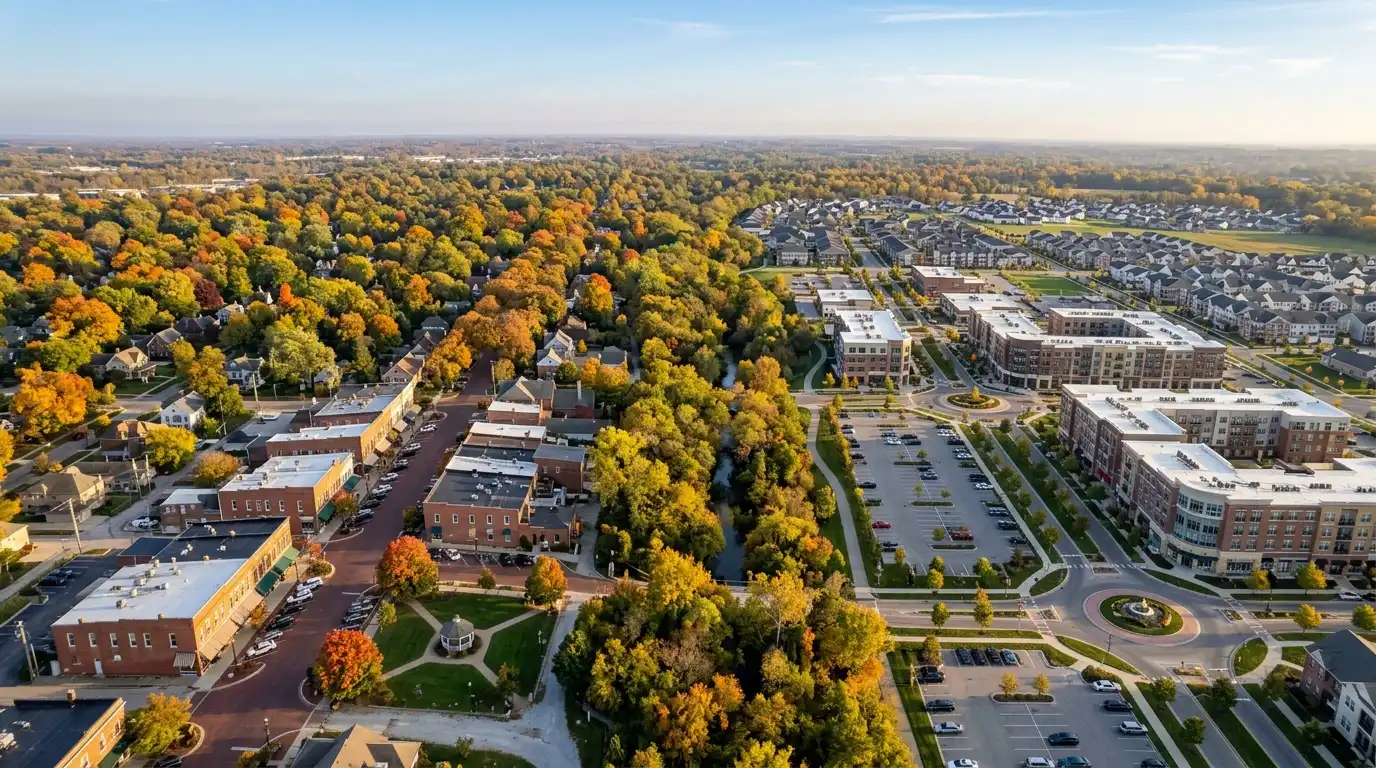
Carmel and Zionsville are not two versions of the same suburb. Carmel is a second class civil city in Hamilton County covering 49.09 square miles with an estimated 105,634 residents, and Zionsville is a consolidated civil town in Boone County covering 67.19 square miles with an estimated 33,624, which means Zionsville holds roughly 37 percent more land with under a third of the people. Choosing between them is mostly a choice between a dense city that has decided to grow up rather than out, and a large low-density town where the tax rate and the school corporation both change depending on which part of the boundary you buy in.
We built this comparison out of structure rather than price, and that was a deliberate decision. MIBOR REALTOR Association, the source of record for closed sales in Central Indiana, publishes its Market Insights Report at county and 17-county-region level only, and nothing below county (Market Insights Report, July 2026, data pulled August 4, 2026). We have not located a measured, published median for either town from any government or association source. The town-level medians on national portals are model output, which is why we do not cite them. So we used what is actually published under a government letterhead: the US Census Bureau, the Indiana Department of Local Government Finance, and the Indiana Department of Education. Structure is also the more durable answer. A median price is stale in ninety days. A taxing district boundary and a form of government will still be true when you sell.
What is the structural difference between Carmel and Zionsville?
They are different kinds of legal entity, in different counties, with different governing bodies. Carmel is a city. Zionsville is a town, and a very unusual one.
| Measure | Carmel | Zionsville |
|---|---|---|
| County | Hamilton | Boone |
| Legal unit name on the tax roll | Carmel Civil City | Zionsville Civil Town |
| Class | Second class city | Civil town, consolidated |
| Executive | Elected Mayor, four-year term | Mayor, under a Mayor-Town Council form |
| Legislative body | Nine council members: three at large, six by district (Districts 1 through 6), four-year terms | Seven council members: five by district, two at large, four-year terms |
| Land area | 49.09 sq mi | 67.19 sq mi |
| Water area | 1.079 sq mi | 0.124 sq mi |
| Population, July 1, 2025 estimate | 105,634 | 33,624 |
| April 1, 2020 estimates base | 99,756 | 30,553 |
| Change since the 2020 estimates base | +5.9% | +10.0% |
| People per square mile of land | about 2,152 | about 500 |
Sources: US Census Bureau, 2024 Gazetteer Files, Indiana places (land and water area). US Census Bureau, Vintage 2025 Subcounty Population Estimates, released for July 1, 2025 (population; the 2020 column is the modified estimates base, not the published 2020 Census count). City of Carmel, City Hall and City Council pages, retrieved August 16, 2026. Town of Zionsville, Town Council and Mayor and Administration pages, retrieved August 16, 2026. Density is our own arithmetic from the two Census figures.
Density is the number that does the most work here. Carmel holds about four times as many people per square mile of land as Zionsville. Everything downstream of that, the housing mix, the road network, the commercial base, the amount of undeveloped ground left, follows from it.
One structural detail is worth pinning down precisely, because it gets copied around and garbled. The Carmel City Council has nine members elected to four-year terms, three at large and six representing Districts 1 through 6. That is the City of Carmel’s own City Council page and its published member roster, retrieved August 16, 2026.
Why does Zionsville have one government where most towns have three?
Because it consolidated. The Town of Zionsville states, in its own Citizens Guide to Local Government, that its structure was created under the Indiana Government Modernization Act, Ind. Code 36-1.5, which the General Assembly enacted in 2006. On May 7, 2007 the Town Council voted, by Resolution No. 2007-06, to reorganize the then unincorporated portions of Eagle Township and Union Township together with the Town of Zionsville into a single political subdivision. On May 20, 2014 the town undertook a second reorganization, by Resolution No. 2014-11, merging the Town of Zionsville and Perry Township, and that second step created the office of Mayor and vested executive power in it.
That history is not trivia. It is why Zionsville covers 67 square miles while its historic Village occupies a few blocks of brick street, and it is why the Zionsville Corporation tax bill has no township line item on it. The townships were absorbed into the town.
The two council vote dates above are verified against the Town of Zionsville’s own Citizens Guide to Local Government. The dates on which the two reorganizations took legal effect are not. We could not confirm an effective date for either step against a town record, so we do not publish one. If an effective date matters to your situation, ask the Town of Zionsville Clerk-Treasurer for the recorded ordinance.
How do property taxes compare between Carmel and Zionsville?
At the headline level, almost identically. Underneath, not at all.
| Taxing district | Taxes payable 2025 | Taxes payable 2026 | Change |
|---|---|---|---|
| Hamilton County district 018, Carmel | 1.9977 | 2.0167 | +0.0190 |
| Boone County district 006, Zionsville Corporation | 1.9795 | 2.0336 | +0.0541 |
Source: Indiana Department of Local Government Finance, Certified Tax Rates by Taxing District, 2025 and 2026 files. Retrieved and read directly from the DLGF workbooks on August 16, 2026. These are gross district rates before any deduction, credit or circuit breaker cap.
The gap between the two headline rates for 2026 is 0.0169 per $100 of assessed value, which is under one percent of either rate. If you were choosing between the two towns on the strength of the headline rate alone, there would be nothing to choose. The composition is where the two towns diverge sharply.
| Levying unit | Carmel (Hamilton 018) | Zionsville Corporation (Boone 006) |
|---|---|---|
| School corporation | 0.8425 (Carmel-Clay) | 1.3000 (Zionsville Community) |
| Municipality | 0.7783 (Carmel Civil City) | 0.4881 (Zionsville Civil Town) |
| County | 0.2737 (Hamilton) | 0.1930 (Boone) |
| Township | 0.0608 (Clay Township) | none |
| Library | 0.0590 (Carmel-Clay Public) | 0.0525 (Hussey-Mayfield Memorial) |
| Solid waste district | 0.0024 | 0.0000 |
| Airport authority | 0.0000 (Hamilton County) | none |
| Total | 2.0167 | 2.0336 |
Source: Indiana Department of Local Government Finance, 2026 Certified Tax Rates by Taxing District and Unit. Fund-level rates read directly from the DLGF workbook and summed by unit on August 16, 2026. Certified for taxes payable 2026.
Read those two columns side by side and the towns describe themselves. Carmel’s municipal levy is about 59 percent larger than Zionsville’s town levy, and it buys a city government running a large public works, engineering and parks operation across a dense 49 square miles. Zionsville’s school levy is about 54 percent larger than Carmel’s, and it is 64 percent of the entire Zionsville Corporation rate against 42 percent in Carmel. Two towns arrive within one percent of each other on the total and get there by nearly opposite routes.
Zionsville is not one tax rate. It is seven.
This is the single most consequential thing a buyer can misunderstand about Zionsville, and it is a direct consequence of the consolidation described above. The town boundary contains multiple certified taxing districts at materially different rates.
| District | 2026 rate | School corporation in that district | Zionsville Civil Town levy |
|---|---|---|---|
| Zionsville Corporation (006) | 2.0336 | Zionsville Community | 0.4881 |
| Eagle/Zionsville Urban Service (029) | 2.0336 | Zionsville Community | 0.4881 |
| Union/Zionsville Urban District (034) | 2.0336 | Zionsville Community | 0.4881 |
| Eagle/Zionsville Rural District (005) | 1.8531 | Zionsville Community | 0.3076 |
| Union/Zionsville Rural District (016) | 1.8531 | Zionsville Community | 0.3076 |
| Worth/Zionsville Rural District (031) | 1.4220 | Lebanon Community | 0.3076 |
| Perry/Zionsville Rural District (013) | 1.3663 | Lebanon Community | 0.3076 |
Source: Indiana Department of Local Government Finance, 2026 Certified Tax Rates by Taxing District and by District and Unit. Read directly from the DLGF workbooks on August 16, 2026. Certified for taxes payable 2026.
The spread inside one town boundary runs from 1.3663 to 2.0336, a difference of 0.6673 per $100 of assessed value. Two parcels a few miles apart, both with a Zionsville mailing address, both paying the Zionsville Civil Town levy, can sit in different school corporations at gross rates that differ by a third. Parcels in the Perry/Zionsville and Worth/Zionsville rural districts are in the Lebanon Community School Corporation, not Zionsville Community Schools, whose own published service area is Eagle and Union townships within Boone County.
Carmel has a smaller version of the same trap. Hamilton County also certifies a district named Carmel Washington, at 2.4068 for 2026, in which parcels pay the Carmel Civil City levy of 0.7783 but sit in the Westfield-Washington School Corporation at 1.2883 rather than Carmel-Clay at 0.8425. That is 0.39 per $100 of assessed value above the main Carmel district, and the difference is almost entirely the school line.
We are not publishing a worked dollar tax bill for a home in either town, and we would treat any comparison that does with suspicion. Converting a certified rate into an actual bill requires the homestead standard and supplemental deductions as amended by Senate Enrolled Act 1 of 2025, which run on two different clocks, plus local income tax relief credits, the supplemental homestead credit added by that act at Section 74 as Ind. Code 6-1.1-20.6-7.7, worth the lesser of 10 percent of the homestead’s tax liability or $300 and applying to taxes first due and payable in calendar years beginning after December 31, 2025, and the circuit breaker caps of 1 percent of gross assessed value for a homestead, 2 percent for other residential and agricultural land, and 3 percent for other property. A wrong worked example is worse than no example.
Sources for this paragraph, both read directly on August 16, 2026: Senate Enrolled Act 1 of 2025 as enrolled, Section 74, and Indiana Department of Local Government Finance, Tax Bill 101.
This article describes how the rules are structured. It is not tax or legal advice. For your own parcel, contact a licensed Indiana tax professional or attorney, and confirm your assessed value, taxing district and deductions with the Hamilton County Assessor or the Boone County Assessor.
How different is the housing stock?
Very. And not in the way people assume. The two towns built most of their housing in the same era. What differs is what they built.
| Measure | Carmel | Zionsville |
|---|---|---|
| Total housing units | 40,859 | 12,066 |
| Single-family detached | 69.9% | 83.9% |
| Single-family attached | 5.6% | 4.5% |
| In structures of three or more units | 23.7% | 11.0% |
| In buildings of 50 units or more | 6.4% | 4.0% |
| Median year structure built | 1998 | 1999 |
| Built 2020 or later | 3.8% (1,572 units) | 4.8% (577 units) |
| Built 2000 to 2019 | 41.0% | 43.6% |
| Built 1939 or earlier | 0.9% (382 units) | 3.7% (445 units) |
| Occupied units, owner-occupied | 74.3% | 84.2% |
| Occupied units, renter-occupied | 25.7% | 15.8% |
Source: US Census Bureau, American Community Survey 2020-2024 five-year estimates, Tables B25024 (units in structure), B25034 (year structure built), B25035 (median year built) and B25003 (tenure), read from the Census table-based Summary File on August 16, 2026. Percentages are our own arithmetic from the published counts. ACS five-year estimates are averages across 2020 through 2024 and carry margins of error.
Three things fall out of that table. First, the median build year is effectively the same, 1998 against 1999, so neither town is meaningfully older housing stock than the other. Second, Carmel has a rental and multifamily sector and Zionsville essentially does not: about one Carmel home in four is renter-occupied against roughly one in six in Zionsville, and Carmel has more than twice the share of units in buildings of three or more. Third, Zionsville has four times Carmel’s share of pre-1940 housing, which is the Village showing up in the data. Zionsville’s own account puts first permanent settlement in the early 1820s and registration with the Boone County recorder in early 1852.
Carmel is explicit about the direction it is heading. Its adopted Carmel Comprehensive Plan 2022 states that the growth of City Center and the improvement of the Monon Greenway through a new Midtown have established a strong urban core, and that the city has, in many ways, begun to grow up instead of out. That is a city telling you in writing that its next decade of housing will be denser than its last. Zionsville’s comprehensive plan is mid-process: the town states that an eighteen-month update produced a draft that received a favorable recommendation from the Plan Commission and has gone to the Town Council for consideration and possible adoption. Until that is adopted, where Zionsville intends to direct new residential growth is not settled in a public document, and we will not guess at it.
What can we say about schools, and what can we not?
We name schools by district, grade range and official enrolment. We do not publish rankings, ratings, test scores or any comparative statement about school quality. That is a fair housing position and it is not negotiable, including when the ranking appears in a town’s own promotional material, which in both of these towns it does.
| Measure | Carmel Clay Schools | Zionsville Community Schools |
|---|---|---|
| Grade range | Prekindergarten and K-12 | Prekindergarten and K-12 |
| Schools | 11 elementary, 3 middle, 1 high school | 6 elementary, 2 middle, 1 high school |
| Enrolment, current reporting year | 15,913 | 8,003 |
| Enrolment, prior year | 16,145 | 7,971 |
| Enrolment, five years earlier | 16,395 | 7,450 |
| Direction over five years | down 482 | up 553 |
Source: Indiana Department of Education, Corporation Enrollment by Grade Level, 2006 through 2026 workbook, tabs 2026, 2025 and 2021, read directly on August 16, 2026. School counts from Carmel Clay Schools and Zionsville Community Schools district websites, retrieved August 16, 2026. Note that the Carmel Clay Schools site describes the district as serving over 16,000 students, while the state’s count for the current reporting year is 15,913.
Zionsville Community Schools names its six elementary schools as Boone Meadow, Eagle, Pleasant View, Stonegate, Trailside and Union, its two middle schools as Zionsville Middle School and Zionsville West Middle School, and its high school as Zionsville Community High School. It publishes its service area as Eagle and Union townships within Boone County. That last sentence is the one to hold onto, because it means a Zionsville address in the Perry or Worth rural taxing districts is not in Zionsville Community Schools at all. Confirm the school corporation for a specific parcel with the county assessor’s record and the district, not with a listing.
How far is each from work?
We are going to answer this the only honest way available, which is with commute data rather than drive times. No mapping authority or INDOT source publishes a drive time from either town to downtown Indianapolis, the airport or the Boone County employment corridor, so no figure is published for this and we will not invent one.
| Measure | Carmel | Zionsville |
|---|---|---|
| Mean travel time to work | 24.6 minutes | 22.7 minutes |
| Workers in the base | 38,897 | 11,547 |
Source: US Census Bureau, American Community Survey 2020-2024 five-year estimates, Tables B08013 (aggregate travel time to work) and B08303 (travel time to work), read from the Census table-based Summary File on August 16, 2026. Mean is our own arithmetic, aggregate minutes divided by workers. Both figures carry margins of error and reflect all destinations, not travel to any single place.
Zionsville’s mean commute is about two minutes shorter than Carmel’s, which surprises people who assume the more distant town commutes longer. It reflects where each town’s workers actually go, not distance to a single downtown.
Be skeptical of any straight-line mileage figure quoted for Zionsville. The town’s geographic center sits in the middle of a 67 square mile boundary, nowhere near the Village where most buyers picture themselves, so a centroid-derived distance overstates the distance to downtown Indianapolis and understates the distance north to Lebanon and the Boone County employment corridor, because the Village sits in the southeastern corner of the town’s boundary. Zionsville Community Schools states that the district is situated in the southeastern corner of Boone County, just 18 miles from downtown Indianapolis, which is the district’s own description rather than a measured figure we are able to verify. Source: Zionsville Community Schools, About ZCS, retrieved August 16, 2026.
What about price?
MIBOR REALTOR Association, the source of record for closed sales in Central Indiana, publishes closed sales, median price, days on market and inventory at county and 17-county-region level only, and nothing below county (Market Insights Report, July 2026, data pulled August 4, 2026). We have not located a measured, published median for either town from any government or association source. Individual Indiana sales are recorded parcel by parcel through the state’s sales disclosure process and the county assessor’s records, but that is a filing record rather than a published town statistic, and we have not compiled one. Deriving a Carmel or Zionsville median from a Hamilton or Boone County median is arithmetic, not measurement, and we do not do it. The town-level medians on the national portals are model output, which is why we do not cite them.
The American Community Survey asks owner-occupants what they think their home would sell for. For 2020 through 2024 combined, that median self-reported value is $486,800 in Carmel, with a margin of error of plus or minus $10,332, and $587,800 in Zionsville, plus or minus $21,572.
This is not a sale price. It is not a list price. It is not current. It is an owner’s own estimate, averaged across five years ending in 2024, and it is the only town-level value figure we located for either place from a primary source. Use it for the direction of the gap between the two towns, not for the size of it, and never as a pricing input on a specific home. Source: US Census Bureau, ACS 2020-2024 five-year estimates, Table B25077, read August 16, 2026.
If you want a real number for a real house, it comes from a comparable sales analysis on the specific parcel, in the specific district, at the specific time you are buying. That is a broker’s job, not an article’s.
So which one fits you?
We are not going to tell you one town is better. We will give you the tests we would apply if we were choosing.
You want walkable density and want it to increase rather than hold steady. You want a genuine range of housing forms, including attached and multifamily, because roughly a quarter of Carmel’s units are in buildings of three or more and a quarter of its occupied homes are rentals. You want an adopted comprehensive plan you can read today that tells you where the city intends to go. You want one dominant taxing district rather than a patchwork, and you are comfortable that Carmel’s municipal levy is the larger share of the bill.
You want land and low density, at roughly a quarter of Carmel’s people per square mile. You want a housing stock that is nearly 84 percent single-family detached with a small historic core rather than a multifamily sector. You are prepared to do parcel-level diligence, because the taxing district and the school corporation both change inside the town boundary. And you accept that Zionsville’s next comprehensive plan is still in front of the Town Council, so its growth direction is less settled in writing than Carmel’s.
Here is the readiness test we would put to anyone choosing between these two. Before you write an offer, can you state, for the exact parcel, its county, its certified taxing district number, its 2026 gross rate, and its school corporation, and have all four confirmed against the county’s record rather than against a listing? In Carmel that is usually straightforward. In Zionsville it is the whole ballgame, because a Zionsville mailing address tells you almost nothing about which of seven districts you are buying into. If you cannot answer those four, you are not comparing the two towns yet. You are comparing two impressions of them.
Frequently Asked Questions
Is Zionsville really bigger than Carmel?
In land area, yes, by a wide margin. The US Census Bureau’s 2024 Gazetteer puts Zionsville town at 67.19 square miles of land against 49.09 for Carmel city, roughly 37 percent more ground. In population it is the reverse: the Census Bureau’s July 1, 2025 estimates are 105,634 for Carmel and 33,624 for Zionsville. That works out to about 2,152 people per square mile in Carmel and about 500 in Zionsville.
Which town has lower property taxes, Carmel or Zionsville?
On the headline district rate for taxes payable in 2026 they are nearly identical: 2.0167 per $100 of assessed value in Hamilton County district 018 (Carmel) and 2.0336 in Boone County district 006 (Zionsville Corporation), a gap of under one percent. But Zionsville contains seven certified taxing districts ranging from 1.3663 to 2.0336, so the honest answer depends entirely on which district a parcel is in. These are gross rates before deductions, credits and the circuit breaker caps. Confirm your own parcel with the county assessor and consult a licensed Indiana tax professional.
Why does the Zionsville tax bill have no township line?
Because the townships were consolidated into the town. The Town of Zionsville states that under the Indiana Government Modernization Act, Ind. Code 36-1.5, its council voted on May 7, 2007 to reorganize the unincorporated portions of Eagle and Union townships with the town, and on May 20, 2014 to merge with Perry Township, which created the office of Mayor. In the 2026 Zionsville Corporation district there is no township levy at all, where the Carmel district carries a Clay Township levy of 0.0608 per $100 of assessed value.
Does a Zionsville address always mean Zionsville Community Schools?
No. Zionsville Community Schools publishes its service area as Eagle and Union townships within Boone County. Parcels in the Perry/Zionsville Rural and Worth/Zionsville Rural taxing districts pay the Zionsville Civil Town levy but are in the Lebanon Community School Corporation. Carmel has a comparable situation: Hamilton County’s Carmel Washington district carries the Carmel Civil City levy alongside the Westfield-Washington School Corporation rather than Carmel-Clay. Always confirm the school corporation for a specific parcel with the county and the district.
How many people are on the Carmel City Council?
Nine, elected to four-year terms, with three at large and six representing Districts 1 through 6, per the City of Carmel’s council page and member roster, retrieved August 16, 2026.
What is the median home price in Carmel or Zionsville?
MIBOR REALTOR Association, the source of record for closed sales in Central Indiana, publishes at county and 17-county-region level only and nothing below county (Market Insights Report, July 2026). We have not located a measured, published median for either town from any government or association source. Town-level medians on national portals are model output, which is why we do not cite them. The only town-level value figure we could source is the American Community Survey’s median self-reported owner-estimated value for 2020 through 2024, which is $486,800 in Carmel and $587,800 in Zionsville. That is what owners think their homes are worth, averaged over five years ending in 2024, not a sale price and not current.
Is the commute longer from Zionsville?
Not on average. The American Community Survey’s 2020-2024 five-year estimates give a mean travel time to work of 22.7 minutes for Zionsville workers and 24.6 minutes for Carmel workers, among those who did not work at home. That reflects where each town’s workers actually go rather than distance to any one destination. We do not publish drive times to downtown Indianapolis or the airport, because no mapping or transportation authority publishes them.
Which town has more new construction?
In share, Zionsville, slightly. In volume, Carmel, by a lot. The American Community Survey’s 2020-2024 estimates show 4.8 percent of Zionsville’s 12,066 housing units built in 2020 or later, which is 577 units, against 3.8 percent of Carmel’s 40,859 units, which is 1,572 units. Where that construction is happening inside each municipality is a question for Plan Commission agendas and approved PUD ordinances, not for a summary statistic.
Explore the communities we serve
Compare the two on your actual parcel
We work across Hamilton and Boone counties, and we will pull the certified taxing district, the school corporation and a comparable sales analysis for any address you are considering before you write an offer. That is the level at which this comparison stops being general and starts being yours.
Start the conversation