

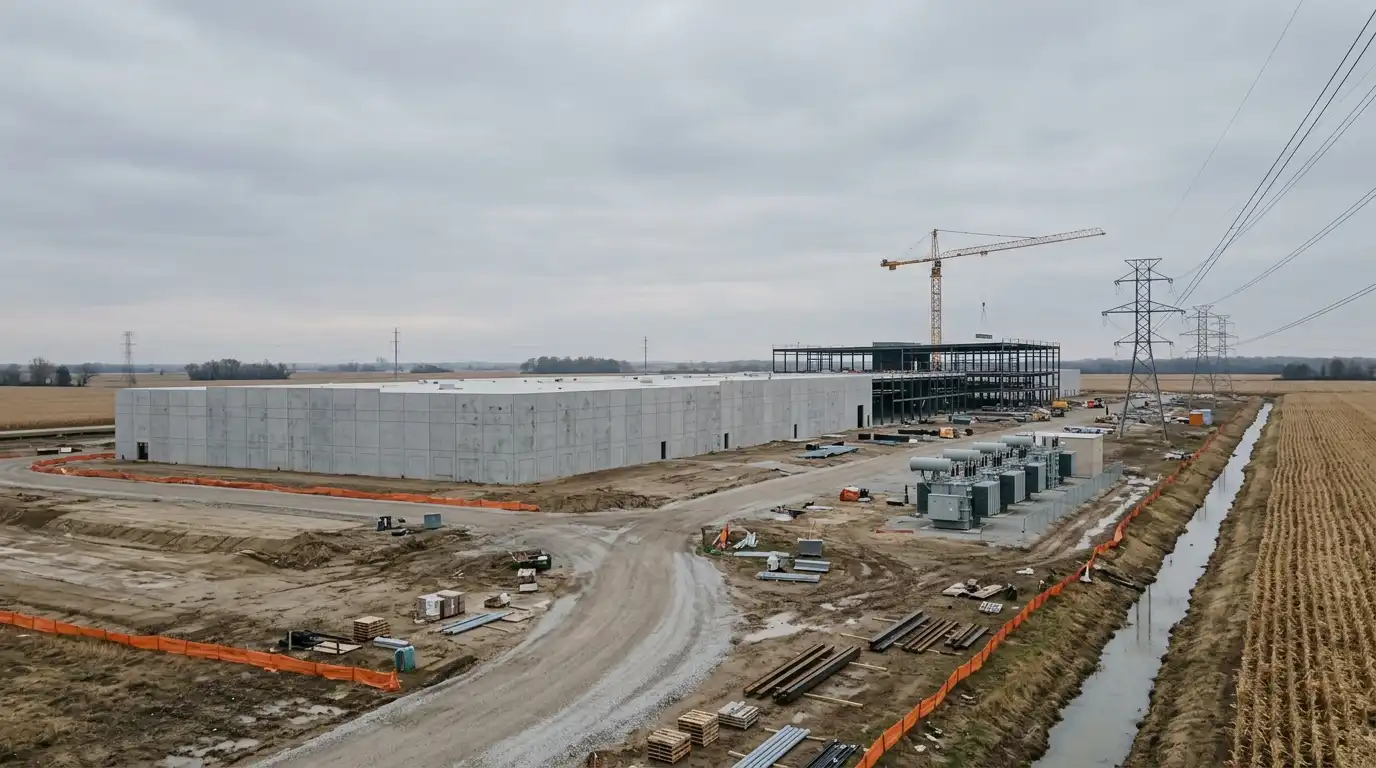
Meta broke ground on a data center campus in Lebanon, Indiana on February 11, 2026, and the company’s own newsroom is the only source we use for what the project is: more than $10 billion of investment, roughly 4 million square feet, 1GW of designed capacity, more than 4,000 construction jobs at peak, and approximately 300 permanent operational jobs. That last number is the one that matters most to Boone County housing, and it is the one that most coverage buries. A campus this size is a very large construction event and a comparatively small permanent employer, and those two things do not act on a housing market the same way.
We work Boone and Hamilton counties every week, and this project comes up in almost every Zionsville, Whitestown and Lebanon conversation we have. Most of what circulates about it is trade reporting, local television, or figures from the proposal stage that were superseded in February 2026. This page separates what has been committed and is under construction from what has only been proposed, and from what has only been reported. On this project that distinction is the entire value of reading further.
What has Meta actually confirmed about the Lebanon campus?
Every figure in the table below comes from Meta’s own published announcements or from the project’s own construction site. We have not used trade coverage, local television, or any real estate portal for any number on this page.
| Item | Figure Meta publishes | Primary source |
|---|---|---|
| Groundbreaking | February 11, 2026 | about.fb.com; datacenters.atmeta.com |
| Investment | More than $10 billion in data center infrastructure and the surrounding community | about.fb.com; datacenters.atmeta.com |
| Campus size | Roughly 4 million square feet | about.fb.com; datacenters.atmeta.com |
| Designed capacity | 1GW of capacity once operational | about.fb.com; datacenters.atmeta.com |
| Construction jobs | More than 4,000 at peak construction | about.fb.com; datacenters.atmeta.com; lebanondatacenter.com |
| Operational jobs | Approximately 300 | about.fb.com; datacenters.atmeta.com |
| Position in fleet | Second in Indiana, 27th in the United States, 31st in the world | datacenters.atmeta.com |
| Builders | Mortenson, Turner Construction Company, Faith Technologies | lebanondatacenter.com |
| First buildings online | Late 2027 | City of Lebanon |
Sources: Meta, “Meta’s New Data Center in Lebanon, Indiana Marks a Milestone in AI Investment,” about.fb.com, February 11, 2026; Meta, “Hello, Lebanon,” datacenters.atmeta.com, February 11, 2026; lebanondatacenter.com, retrieved August 16, 2026; City of Lebanon, LEAP Lebanon page, lebanon.in.gov, retrieved August 16, 2026.
What Meta’s newsroom does not say
Three absences are worth naming, because each one has been filled in elsewhere with a number we will not repeat.
Meta publishes square footage, not acreage. No Meta announcement, and no page on the project’s own construction site, states how many acres the campus covers. A widely repeated acreage figure exists in trade and local coverage. It appears in no primary source we could find, so we do not publish it. If you need the land area for a specific reason, the Lebanon plan commission file is the record to request.
Second, the dollar figures reported during the proposal and negotiation stages in 2025 have been superseded. Meta’s February 2026 announcement of more than $10 billion is the current, company-published number. Repeating the earlier, smaller projections now would be actively misleading, so we have left them out entirely.
Third, Meta’s two newsroom properties name different recipients for the same community fund. The about.fb.com post attributes the $1 million per year for 20 years to the Boone REMC Community Fund. The datacenters.atmeta.com post attributes $1 million annually to the Boone County Community Trust. The commitment, the amount and the purpose, direct assistance with energy costs for families in need, are consistent across both properties. The named recipient is not. We flag the inconsistency rather than pick one, and we would treat the fund name as unsettled until Meta or the fund itself resolves it.
- Committed and under construction: the Meta campus itself. Ground was broken February 11, 2026, three general contractors are named, and the City of Lebanon states Meta expects the first buildings to come online in late 2027.
- Committed by the utilities: the Citizens-Lebanon Water Supply Program, which Citizens Energy Group says it commenced in 2024, with delivery phases published by Lebanon Utilities for 2027, 2028 and 2031.
- Projected, not committed: the employment figure for the surrounding district. The Indiana Economic Development Corporation states that “at full build, LEAP Lebanon will be home to hundreds of companies, employing over 50,000 employees.” That is an IEDC projection at full build for the entire district, not a count of jobs created, coming, or committed.
- Reported only: campus acreage, land prices per acre, and district spending totals. We publish none of these because no primary source we retrieved supports them.
Where does the campus sit inside the LEAP Lebanon Innovation District?
The correct name is the LEAP Lebanon Innovation District, and keeping “Lebanon” in it matters. IEDC refers to “LEAP Districts” in the plural on its own project page, so LEAP is a state program that can carry more than one district. Lebanon is what pins this one to Boone County. On the acronym itself, the City of Lebanon states on its own site that “The Limitless Exploration Advanced Pace (LEAP) project was launched by the IEDC.” That expansion is the city’s wording, attached by the city to the project. IEDC’s own page does not expand the acronym, so do not attribute the expansion to the state.
IEDC markets the district as “9,000+ acres ready to parcel for manufacturing or R&D facilities or corporate campuses,” and the Indiana Department of Transportation independently describes “The planned 9,000 acre LEAP Innovation and Research District” in its own project materials. That figure describes district planning and available acreage. It is not a statement that any single agency has bought, assembled or owns 9,000 acres, and IEDC’s own site notes that the boundaries and proposed improvements shown on its site map “are conceptual only” and “are subject to change.” If a specific parcel’s status inside or outside the district matters to a decision you are making, that is a question for the City of Lebanon and the Boone County offices of record, not for a marketing map.
Sources: Indiana Economic Development Corporation, LEAP Lebanon project page, iedc.in.gov/leap-lebanon, retrieved August 16, 2026, no publication date shown; Indiana Department of Transportation, SR 32 New Alignment in Boone County project page, in.gov/indot, retrieved August 16, 2026; City of Lebanon, LEAP Lebanon page, lebanon.in.gov, retrieved August 16, 2026, no publication date shown.
How many permanent jobs does a data center actually create?
Meta’s own two numbers answer this more clearly than any commentary could. More than 4,000 construction workers at peak. Approximately 300 permanent operational jobs, a figure published on both of Meta’s newsroom properties. The ratio is roughly thirteen to one, and it runs in the opposite direction from what most local coverage implies when it leads with the construction figure.
Both numbers need reading carefully. “At peak” is a single point on a multi-year construction schedule, not a steady state. It is the maximum simultaneous headcount, reached once, and it ends when the campus is built. Meta publishes no figure for how many of those workers will live in Boone County rather than commute in or lodge temporarily during their scope of work. No figure is published for this, and we will not estimate one.
The operational number is the durable one, and it comes with its own gap. Meta has not published a staffing timeline for reaching approximately 300, nor a breakdown of what those roles are. So the honest reading is a headcount with no published schedule attached to it.
What 300 jobs means against Boone County transaction volume
Here is the arithmetic, done honestly and out loud. Boone County recorded 775 single-family closed sales in the first seven months of 2026 alone, according to MIBOR. Approximately 300 permanent positions is under half of that seven-month figure, and those positions will be filled at some point following the first buildings coming online in late 2027, on a schedule Meta has not published.
Then subtract further. Some of those roles will be filled by people who already live in Boone, Hamilton or Marion counties and will not move at all. Some will rent rather than buy. Some will buy well outside the county and commute. A data center is not a factory shift; it is a small, technical, around-the-clock operations staff. The honest conclusion is that the permanent employment at this campus, taken by itself, is not large enough to move a county-level housing market of this size, and anyone telling you otherwise is selling urgency.
That is a narrower claim than “this project will not affect Boone County.” The campus is one tenant in a district that IEDC projects will eventually hold hundreds of companies. The demand case for Boone County, if there is one, rests on that district filling in over a decade, not on 300 badge holders.
What has actually happened to Boone County prices since the announcement?
Meta announced the Lebanon campus and broke ground on February 11, 2026. Here is what the county’s residential market has done through the most recent published month.
| Boone County, single family | July 2026 | July 2025 | Change |
|---|---|---|---|
| Median sales price | $418,000 | $459,500 | -9.03% |
| Closed sales | 137 | 115 | +19.13% |
| New listings | 128 | 126 | +1.59% |
| Active inventory | 213 | 214 | -0.47% |
| Months supply of inventory | 1.6 | 1.9 | -16.45% |
| Percent of list price received | 99.2% | 98.7% | +0.56% |
| Median sales price, year to date | $410,000 | $430,000 | -4.65% |
| Closed sales, year to date | 775 | 645 | +20.16% |
Source: MIBOR REALTOR Association, Market Insights Report, July 2026, page 14 (Boone County), data provided by the MIBOR Broker Listing Cooperative and pulled 08/04/26. Single family residence only; MIBOR does not publish condominium data below its 17-county regional level, and publishes no data at town, township or ZIP code level. Year-to-date columns cover January through July. Active inventory and months supply are point-in-time end-of-period readings, not totals. Read directly from the source report on August 16, 2026.
Read that table before accepting any story about a data center price surge. Boone County’s median sale price is down year over year on both a monthly and a year-to-date basis, while closed sales are up roughly 19 to 20 percent on both bases. Volume rose and price fell, in the same county, in the same period during which a more than $10 billion campus broke ground inside it.
We are not claiming the data center pushed prices down. We are claiming the opposite of a claim: this data does not support a story in which the announcement lifted county prices, and it is the only county-level data published by the association that runs our MLS. A median is also a mix measure. When more entry-level and new-construction product closes, the median can fall while individual homes hold value. MIBOR’s reported new construction sales price for Boone County in July 2026 was $400,450, roughly four percent below the county’s overall median of $418,000 for the same month, which is consistent with a mix that has shifted toward more modestly priced new product.
For comparison, Hamilton County’s single-family median for July 2026 was $489,990. The two counties are on different trajectories and should not be discussed as one market. If your search spans both, that difference is worth a conversation before you write an offer.
Source for Hamilton County: MIBOR REALTOR Association, Market Insights Report, July 2026, page 17 (Hamilton County), single family residence, data pulled 08/04/26.
Who pays for the water, and who pays for the power?
Water and power are the genuinely contested part of this project locally, and they are also where the most unsourced claims circulate. We handle both from primary documents only: what the company published, and what the utilities published. We do not characterize either side of the local debate, and we do not publish any estimate of what the campus will actually consume. Meta publishes 1GW of designed capacity, which is a design figure, not a consumption figure.
What Meta commits to on water and energy
These are commitments Meta published on February 11, 2026, in its own voice. They are statements of intent by the company, not independently verified outcomes, and we present them as such, in our own words rather than as quotations.
- Meta states the data center will use a closed-loop, liquid-cooled system that recirculates the same water, and will use zero water for a majority of the year.
- Meta states it will restore 100% of the water it consumes in Lebanon to local watersheds.
- Meta states it pays the full cost of energy used by its data centers, and will pay the full cost of water and wastewater service required to support the data center.
- Meta states it will match 100% of the new data center’s energy use with clean energy, and says it worked with Boone Power and Wabash Valley Power Alliance from the beginning to plan for its energy needs.
- Meta states it is investing more than $120 million toward critical water infrastructure in Lebanon, alongside other public infrastructure improvements including roads, transmission lines and utility upgrades.
- Meta is partnering with Arable to provide irrigation technology to independent farmers in Indiana’s Upper Wabash River Basin, a project it says will restore 200 million gallons of water a year for ten years, and is revitalizing a section of Deer Creek.
- Meta states the campus will achieve LEED Gold certification once operational.
- Meta funds emergency water utility assistance through The Caring Center for approximately 500 families, and commits $1 million each year for 20 years toward direct energy bill assistance for local families.
Sources: Meta, about.fb.com and datacenters.atmeta.com, both February 11, 2026, retrieved August 16, 2026. Rendered in indirect speech. Where we have not verified a sentence character for character against the live page, we do not put it in quotation marks.
What the utilities publish
The regional water supply is a separate program with its own public record, and it predates the Meta groundbreaking. Citizens Energy Group states that it commenced the Citizens-Lebanon Water Supply Program in 2024 to supply water to Lebanon Utilities as a wholesale customer, and that by 2031 the program will enable delivery of up to 25 million gallons per day. Citizens puts project costs at just more than $560 million, financed through Indiana’s Drinking Water State Revolving Fund, and states that Citizens customers will not pay the program costs.
Citizens also publishes a direct correction to the most common local claim about the program. Its Myths vs Facts document addresses the idea that Citizens is planning to send 25 million gallons per day directly from Eagle Creek Reservoir to the LEAP District, and states that Citizens has agreed to provide up to 25 million gallons per day to Lebanon Utilities as a wholesale customer rather than directly to the district, that the water would come from the entire Citizens water system rather than from Eagle Creek alone, and that there is no direct pipeline from Eagle Creek to the LEAP District. That distinction matters for reading anything else about this program: the counterparty is a municipal utility, not a campus.
| Phase | Year | Delivery capacity |
|---|---|---|
| Phase 1 | 2027 | Up to 2 million gallons per day |
| Phase 2 | 2028 | Up to 10 million gallons per day |
| Phase 3 | 2031 | Up to 25 million gallons per day |
Source: Lebanon Utilities, Wholesale Water Supply Program page, lebanon-utilities.com, retrieved August 16, 2026. Lebanon Utilities publishes Phase 1 construction as including a 2-million-gallon ground storage tank, a pressure booster station, 48,500 feet of large-diameter transmission lines, and a 2-million-gallon elevated storage tank south of SR 32. Citizens Energy Group, Citizens-Lebanon Water Supply Program page, info.citizensenergygroup.com/clws, retrieved August 16, 2026.
On the question every Boone County homeowner actually asks, Lebanon Utilities publishes two things. It states that current LU customer rates will not increase due to the project. It also publishes, verbatim, that “loan repayment will come from sewer rates within the LEAP Innovation District, not existing customers.” That is the utility’s own published position as of August 16, 2026. It is a statement of policy, not a guarantee against any future rate case, and rate structures are set through public processes that can be attended and commented on.
Neither Meta’s announcements nor the project’s construction site publishes a property tax figure or an abatement schedule for this campus, and we do not cite one here. Indiana’s homestead deduction structure also changed substantially under recent state legislation, and how any of it lands on a specific bill depends on the taxing district, the assessed value and the credits that apply.
We describe rules on this page; we do not give tax or legal advice. For your own situation, consult a licensed Indiana tax professional or an Indiana attorney, and contact the Boone County Assessor for the assessed value and taxing district of your own parcel.
What should a Boone County buyer or seller do with this?
Not much, urgently, and that is the useful conclusion rather than a disappointing one.
If you are buying, the campus is a reason to understand the corridor, not a reason to accelerate. Meta’s first buildings are expected late 2027, and the regional water program runs on its own separate schedule. That program is not a Meta project. Citizens Energy Group commenced it in 2024, two years before the Meta groundbreaking, to supply Lebanon Utilities as a wholesale customer, and Lebanon Utilities separately serves its own customers, including users inside the district. If you want a sense of scale, use the published capacity rather than an inference: Lebanon Utilities publishes Phase 3 at up to 25 million gallons per day by 2031. Nothing in either schedule rewards overpaying in 2026.
What does reward attention is inventory. Boone County was at 1.6 months of supply at the end of July 2026. Months supply has been tight across the MIBOR service area generally, which stood at 2.2 months in July 2026 with active inventory up 17.35% year over year. No published data attributes Boone County inventory levels to the data center, and we are not going to invent an attribution in either direction.
Source: MIBOR REALTOR Association, Market Insights Report, July 2026, page 2 (MIBOR Market Summary, 17-county service area) and page 14 (Boone County), single family residence, data pulled 08/04/26. Months supply and active inventory are point-in-time end-of-period readings.
If you are selling, be careful about pricing to a narrative. The county’s median is down year over year on both a monthly and a year-to-date basis. Buyers in this corridor are informed, and a list price built on a press release rather than on comparable sales is the most common way we see Boone County listings lose their first three weeks.
If you own land near the district, the questions that matter are parcel-specific: municipal boundaries, zoning, annexation status, and utility service. Those are answered by the City of Lebanon, the Boone County Area Plan Commission and the county offices of record. They are not answered by an acreage figure in a trade publication, and we would rather help you request the right file than repeat one.
Frequently Asked Questions
How much is Meta investing in the Lebanon data center?
Meta’s February 11, 2026 announcement states more than $10 billion in data center infrastructure and the surrounding community. That figure supersedes the smaller investment numbers that circulated during the 2025 proposal and negotiation stages, which we do not repeat because they are no longer current.
How many permanent jobs will the Meta data center create?
Meta publishes approximately 300 operational jobs, on both about.fb.com and datacenters.atmeta.com. Separately, Meta expects more than 4,000 construction workers on site at peak construction, but that is a temporary maximum during the build, not an ongoing employment level. Meta has not published a staffing timeline for reaching the operational headcount.
How many acres is the Meta campus in Boone County?
Meta does not publish an acreage figure. It publishes roughly 4 million square feet of campus. An acreage number circulates widely in trade and local coverage, but it appears in no primary source we could retrieve, so we do not publish it. The Lebanon plan commission filing is the record to request if you need it.
Will the data center raise Boone County home prices?
The published data does not show that happening so far. Boone County’s single-family median sale price was $418,000 in July 2026, down 9.03% from July 2025, and $410,000 year to date against $430,000 for the same period in 2025, per MIBOR. Closed sales rose about 19 to 20 percent on both bases over the same period. Volume rose and price fell. Approximately 300 permanent jobs, with no published staffing schedule, is not enough to move a county market of this size on its own.
When will the Meta data center open?
The City of Lebanon states that Meta expects the first buildings at the Lebanon campus to come online in late 2027. Ground was broken February 11, 2026. Meta has not published a completion date for the full campus or a staffing timeline.
Who is paying for the water infrastructure, and will my rates go up?
Citizens Energy Group states its Citizens-Lebanon Water Supply Program is estimated at just more than $560 million, financed through Indiana’s Drinking Water State Revolving Fund, and that Citizens customers will not pay the program costs. Lebanon Utilities states that current LU customer rates will not increase due to the project, and publishes that “loan repayment will come from sewer rates within the LEAP Innovation District, not existing customers.” Separately, Meta states it is investing more than $120 million toward critical water infrastructure in Lebanon. These are published utility and company positions, not guarantees against any future rate case. Rates are set through public processes you can attend.
Is the water program a Meta project, and will the data center use a lot of local water?
The water program is not a Meta project. Citizens Energy Group states it commenced the Citizens-Lebanon Water Supply Program in 2024, two years before the Meta groundbreaking, to supply Lebanon Utilities as a wholesale customer. Lebanon Utilities separately serves its own customers, including users inside the LEAP Lebanon Innovation District. Citizens publishes a Myths vs Facts document specifically addressing the claim that water would run directly from Eagle Creek Reservoir to the district, and states there is no direct pipeline from Eagle Creek to the LEAP District. On the campus itself, Meta publishes commitments, not consumption figures, and we do not estimate consumption. Meta states the campus will use a closed-loop, liquid-cooled system that recirculates the same water and will use zero water for a majority of the year, that it will restore 100% of the water it consumes in Lebanon to local watersheds, and that it will pay the full cost of water and wastewater service. Those are company commitments published by the company, not independently verified outcomes.
What is the LEAP Lebanon Innovation District, and how big is it?
It is an Indiana Economic Development Corporation project in Boone County. IEDC markets it as “9,000+ acres ready to parcel for manufacturing or R&D facilities or corporate campuses,” and INDOT independently describes “The planned 9,000 acre LEAP Innovation and Research District.” IEDC also notes that the boundaries and proposed improvements shown on its site map “are conceptual only” and “are subject to change,” so treat 9,000 acres as district planning and available acreage rather than a fixed boundary or a land holding by any single agency.
Is the 50,000 jobs figure for the LEAP district real?
It is an IEDC projection, and it should never be stated as jobs created, coming or committed. IEDC’s published wording is that “at full build, LEAP Lebanon will be home to hundreds of companies, employing over 50,000 employees.” That describes the entire district at a full build with no published date, not Meta’s campus and not anything currently under contract.
- Whitestown, in Boone County, where much of the county’s new construction activity sits
- Zionsville, the other side of Boone County and a different price tier
- Westfield and Noblesville, for buyers weighing Hamilton County alternatives
- Carmel and Fishers, for the established north-side comparison
We track the Boone and Hamilton County data every month and we read the primary documents, not the headlines. If you are weighing a move in the corridor, we will show you what the record supports and what it does not.
Talk to our team