

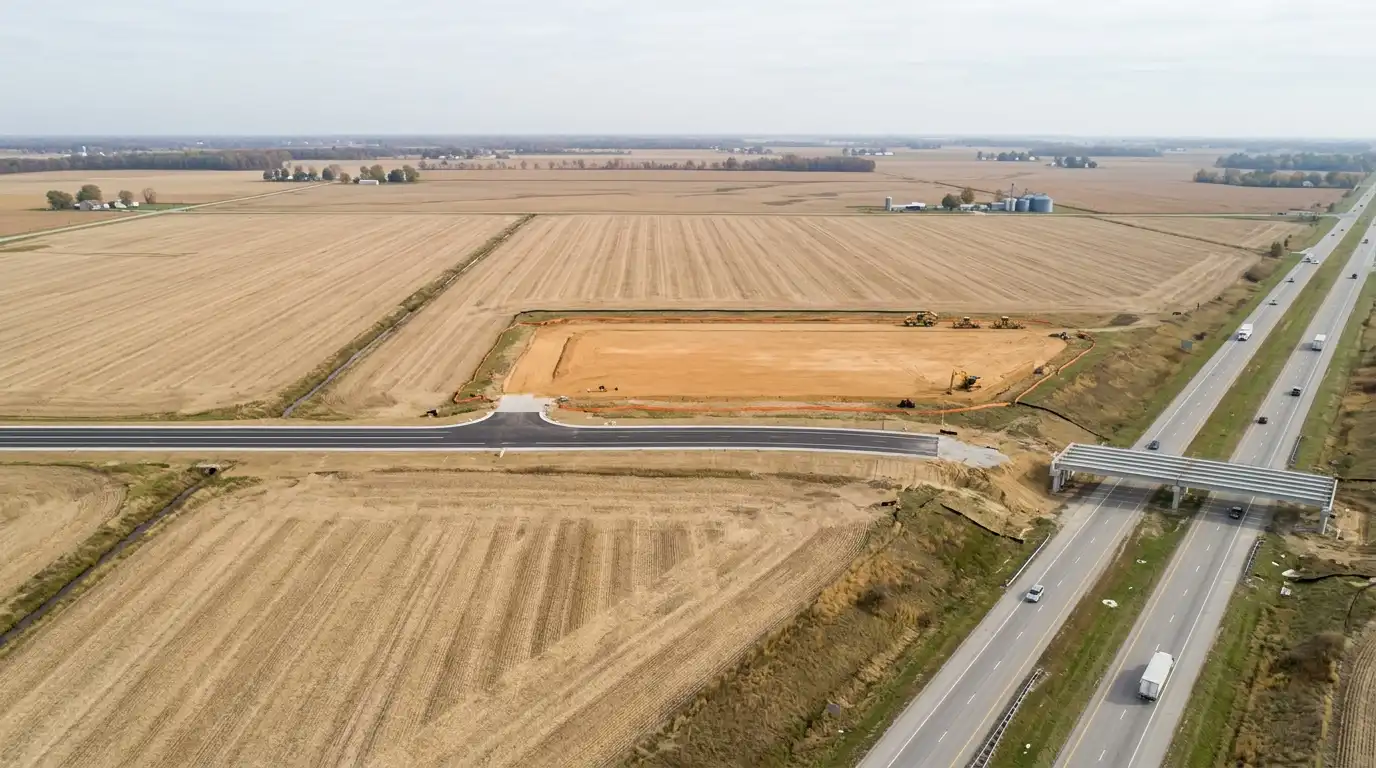
The LEAP Lebanon Innovation District is an Indiana Economic Development Corporation project on the north side of Lebanon in Boone County, which the IEDC markets as “9,000+ acres ready to parcel for manufacturing or R&D facilities or corporate campuses.” Eli Lilly and Meta have each published multi-billion-dollar capital commitments to sites in Lebanon, and the road, water and sewer work serving the corridor is documented in state agency and utility records. What nobody can honestly tell you, including us, is what any of that does to the value of one specific house in Zionsville, Whitestown or Lebanon, because no public dataset measures that.
That gap between what is documented and what is knowable is why this page exists. Almost everything written about LEAP online blurs three very different categories together: money that has been spent on things that now physically exist, numbers that are forecasts published by the agency promoting the district, and ideas that are currently nothing more than a request for proposals. We separate them here, name the source and the date for every figure, and then say plainly what a homeowner or a buyer can reasonably conclude. Where a number is not published by a primary source, we say that instead of estimating one.
What is the LEAP Lebanon Innovation District?
The district’s name matters more than it looks. The IEDC calls it the LEAP Lebanon Innovation District on its own project page, and the same page refers to “LEAP Districts” in the plural, which tells you LEAP is a state program that can carry more than one site. The word “Lebanon” is what pins this one to Boone County. If you see it written as simply “the LEAP Innovation District,” that phrasing is geographically ambiguous about the exact thing a Boone County buyer is asking about.
The City of Lebanon’s own LEAP page states verbatim that “The Limitless Exploration Advanced Pace (LEAP) project was launched by the IEDC.” That expansion of the acronym comes from the city, not from the IEDC, and the city attaches it to the “project” rather than offering it as the district’s formal name. We note the distinction because it is the kind of small inaccuracy that gets copied from site to site until it looks official.
On size, the IEDC publishes “9,000+ available acres strategically situated on Indiana’s I-65 Hard Tech Corridor,” and the Indiana Department of Transportation independently describes “the planned 9,000 acre LEAP Innovation and Research District” on its S.R. 32 project page. Two separate state agencies using the same figure is about as good as this kind of number gets. It is worth understanding what the figure is and is not: it describes district planning and available acreage. It is not a statement that the IEDC purchased, assembled or owns 9,000 acres, and we have not seen a primary source that says so.
For position, the IEDC describes the site as “located at the midpoint of a 70-mile technology corridor that connects Indianapolis to … Purdue University,” with an “experienced workforce of 1 million+ within a radius of 60 minutes.” Those are the IEDC’s own marketing statements about the site, quoted as such.
Source: Indiana Economic Development Corporation, LEAP Lebanon project page, iedc.in.gov, retrieved August 16, 2026 and re-checked August 17, 2026. The page carries no publication or last-updated date. City of Lebanon LEAP page, lebanon.in.gov, retrieved August 16, 2026 and re-checked August 17, 2026, likewise undated. INDOT, “SR 32 New Alignment in Boone County,” in.gov, retrieved August 16, 2026, undated.
The IEDC’s own project page carries this disclaimer: “Boundaries and proposed improvements shown on the site map are conceptual only, to be used for planning purposes, and are subject to change.” Anyone showing you a hard LEAP boundary line and telling you your parcel is inside or outside it should be asked which adopted document that line comes from. Transportation project narratives are not boundary authorities, and the two INDOT descriptions we found differ from each other: a December 2022 INDOT and FHWA public notice for the I-65 and US 52 interchange, reproduced by the City of Lebanon, described “the anticipated 7,000-acre LEAP Innovation and Research District being developed east and west of I-65 (north of Lebanon)” as a future traffic generator, while INDOT’s current S.R. 32 page uses 9,000 acres. The 2022 figure was a traffic-forecasting assumption inside highway paperwork, not a determination of land area.
What is actually committed and under construction?
This is the part of the story that does not depend on anyone’s forecast. Two companies have published their own capital commitments in their own newsrooms, and the buildings exist or are being built.
Eli Lilly and Company announced on May 6, 2026 an additional $4.5 billion investment across two of its three Lebanon sites, which the company said brought its total Indiana capital expansion commitments since 2020 to more than $21 billion. The same release announced the opening, that day, of Lilly Lebanon Advanced Therapies, described by the company as its first dedicated genetic medicine manufacturing facility and as the first of three planned sites on the Lebanon campus, alongside Lilly Lebanon API and the Lilly Medicine Foundry. Lilly chair and chief executive David A. Ricks stated in that release: “When our Lebanon API site opens in 2027, it will be the largest API production site in U.S. history, a commitment we chose to build here, at home.” The release also states that Lilly’s United States capital expansion commitments since 2020 total more than $50 billion.
Meta’s February 2026 announcement of its Lebanon data center describes an investment of more than $10 billion in data center infrastructure and the surrounding community, a campus of roughly 4 million square feet, and 1GW of capacity once operational. Meta says the project will support more than 4,000 construction jobs at peak and approximately 300 operational jobs, and that it is Meta’s second data center in Indiana, its 27th in its United States fleet and its 31st in the world.
Which of these is actually inside the district?
This is worth separating, because the two sitings do not rest on the same evidence. For Lilly, the December 2022 INDOT and FHWA public notice reproduced by the City of Lebanon states that the district “includes the Eli Lilly and Company campus,” and the City of Lebanon published the May 6, 2025 Medicine Foundry groundbreaking as having taken place within the LEAP district. That is two government sources placing Lilly inside it.
Meta is a different case, and we describe it the way the record actually reads. The City of Lebanon presents the Meta campus as part of LEAP on its own LEAP page, which carries a “More About Meta” section and states that “State Road 32 runs between the Meta and Foundry sites.” Meta’s own two publications locate the campus in “Lebanon, Indiana” and never use the word LEAP at all. We have not obtained an adopted boundary document placing the campus inside the district, so we report the city’s presentation of it as the city’s, rather than asserting the siting ourselves. On a page that asks you to demand an adopted document from anyone drawing a hard LEAP line, we are not going to draw one.
| Item | Lilly, Lebanon campus | Meta, Lebanon data center |
|---|---|---|
| Headline figure | $4.5 billion additional, May 2026; more than $21 billion in Indiana since 2020 | More than $10 billion |
| Physical scale published | Three planned sites on one campus | Roughly 4 million square feet; 1GW capacity once operational |
| Status | Advanced Therapies opened May 6, 2026; API site stated to open 2027 | Under construction; first buildings expected online late 2027 |
| Employment published | No current site job count published by the company in this release | More than 4,000 construction jobs at peak; approximately 300 operational |
| Campus acreage | Not published in this release | Not published by Meta in either newsroom post |
| Placed inside LEAP by | INDOT public notice, December 2022, and the City of Lebanon, May 2025 | The City of Lebanon’s LEAP page. Meta’s own posts say “Lebanon, Indiana” and do not name the district |
Sources: Eli Lilly and Company news release, May 6, 2026, full text hosted by the City of Lebanon at lebanon.in.gov, PDF read directly August 17, 2026. Meta, “Hello, Lebanon” at datacenters.atmeta.com and “Meta’s New Data Center in Lebanon, Indiana” at about.fb.com, both February 11, 2026, retrieved August 17, 2026. INDOT and FHWA public notice of December 12, 2022, reproduced at lebanon.in.gov. City of Lebanon, “Ground broken on Lilly Foundry within LEAP district,” May 6, 2025. Late 2027 first-buildings timing per the City of Lebanon LEAP page, retrieved August 16, 2026 and re-checked August 17, 2026.
Two things about that table deserve emphasis. First, a specific acreage figure for the Meta campus circulates widely in trade and local coverage. It appears in nothing Meta published, and Meta publishes square footage rather than acres, so we do not carry an acreage number for the campus at all. Second, Meta’s own two publications name different recipient funds for its energy-assistance commitment of $1 million each year for 20 years, so we describe the commitment without naming the fund.
Lilly Lebanon Advanced Therapies is open. Meta’s campus is under construction. The 52@65 interchange has passed environmental approval, land acquisition, letting and start of construction, all marked complete on INDOT’s own project schedule. Those four statements rest on primary sources from the parties doing the work, and none of them depends on a forecast holding true.
Meta also published community and utility commitments that a Boone County homeowner has a direct interest in: more than $120 million toward critical water infrastructure in Lebanon and other public infrastructure improvements including roads, transmission lines and utility upgrades; a statement that it pays the full cost of the energy its data centers use; a closed-loop, liquid-cooled design; and a commitment to restore 100% of the water it consumes in Lebanon to local watersheds, plus an irrigation partnership Meta says will restore 200 million gallons of water a year for ten years in the Upper Wabash River Basin. Those are the company’s own published commitments. We report them as commitments, not as outcomes, because none of them can be verified as delivered yet.
Which numbers are projections rather than commitments?
The single most repeated number about LEAP is a projection. The IEDC states on its project page that “At full build, LEAP Lebanon will be home to hundreds of companies, employing over 50,000 employees,” and the City of Lebanon repeats it with a counter reading “Jobs Forecasted 50,000+.” That figure is a forecast by the agency whose job is to market the district, at an undefined future date called full build. It is not jobs created, not jobs coming and not jobs committed, and anyone presenting it as any of those three is misreading the source.
We are not saying the number is wrong. We are saying it belongs in a different column from Lilly’s opened building and Meta’s poured foundations, and that a homeowner making a decision should weight it accordingly.
The mixed-use village is a third category again. The City of Lebanon’s LEAP page states that proposals are being sought for LEAP’s mixed-use village. A request for proposals is a solicitation. At the time of writing there is no published acreage, budget, program or selected developer that we could obtain from a primary source, and the IEDC’s own newsroom did not yield the RFP document. If a residential component of LEAP matters to your decision, that is the file to watch, and today it is close to empty.
Source: Indiana Economic Development Corporation, LEAP Lebanon project page, iedc.in.gov, retrieved August 16, 2026 and re-checked August 17, 2026. The page carries no publication or last-updated date, so the retrieval date is the only period available. City of Lebanon LEAP page, lebanon.in.gov, retrieved August 16, 2026 and re-checked August 17, 2026, likewise undated. The 50,000 figure is stated by both as a projection at full build, with no date attached to full build.
What infrastructure is funded, and who repays it?
Infrastructure is the most honest leading indicator available, because roads and water mains have contracts, letting dates and repayment sources attached to them. Here the record is unusually clear, with one exception that we are going to flag rather than paper over.
| Project | What it is | Published status |
|---|---|---|
| 52@65 interchange | INDOT improvement of the I-65 and US 52 interchange, 0.28 miles north of CR 300 N near Lebanon, using state and federal funds | Milestones through “Construction Begins, Spring 2025” marked complete. INDOT’s project schedule shows “November 2026 Full Interchange Open,” while the FAQ on the same site says construction started in Spring 2025 “with final construction complete by Spring 2027,” and both pages still describe the project as currently in the design phase. We could not reconcile the two, and we are not publishing either as the opening date |
| S.R. 32 New Alignment | Proposed realignment and widening from CR 500 W southeast just over four miles to west of Garrofolo Boulevard, widening to four travel lanes east of CR 250 W, with pedestrian facilities anticipated | Described as proposed. INDOT’s page publishes no funding, letting date or construction status |
| Citizens-Lebanon Water Supply Program | Wholesale water from Citizens Energy Group to Lebanon Utilities, enabling up to 25 million gallons per day by 2031 | Underway. Costs currently estimated at just more than $560 million, financed through Indiana’s Drinking Water State Revolving Fund |
| Lebanon Utilities delivery phases | Phase 1 in 2027 up to 2 MGD, Phase 2 in 2028 up to 10 MGD, Phase 3 in 2031 up to 25 MGD | Phase 1 construction includes a 2-million-gallon ground storage tank, a pressure booster station, 48,500 feet of large-diameter transmission lines and a 2-million-gallon elevated storage tank south of S.R. 32 |
Sources: INDOT project site 52at65.com, home, About and FAQ pages, retrieved August 17, 2026. INDOT, “SR 32 New Alignment in Boone County,” in.gov, retrieved August 16, 2026. Citizens Energy Group, Citizens-Lebanon Water Supply Program, retrieved August 16, 2026. Lebanon Utilities, Wholesale Water Supply Program, retrieved August 16, 2026. No construction cost is published for the 52@65 interchange by INDOT, so none is stated here. Anyone who needs a firm interchange opening date should ask INDOT’s Crawfordsville District directly.
On who pays, both utilities have published statements that a homeowner should read directly rather than take secondhand. Citizens Energy Group states that its customers will not pay the program costs. Lebanon Utilities states that current LU customer rates will not increase due to the project, and that “loan repayment will come from sewer rates within the LEAP Innovation District, not existing customers.” Citizens has also published a myths-and-facts response to the most common claim about the water program, quoted by the City of Lebanon: “Citizens has agreed to provide up to 25 million gallons per day to Lebanon Utilities as a wholesale customer, not directly to the LEAP District. That water will come from the entire Citizens water system, not from Eagle Creek alone.”
Water in this corridor is genuinely contested, and we are not going to pretend otherwise. On April 13, 2026 the City of Lebanon issued a formal response to the Indianapolis-Marion County City-County Council about the water supply program and proposed wastewater infrastructure, in which the city stated that “critical aspects of the project, including final discharge locations, remain under active, data-driven evaluation.” We have read the city’s side of that exchange. We have not obtained the Council’s own letter or resolution, so we are not characterizing the dispute beyond that.
What has Boone County housing actually done?
Here is where the honest answer disappoints people. Boone County’s housing market can be measured. What cannot be measured is how much of the movement is LEAP, because there is no counterfactual Boone County running without a LEAP district next to it.
| Metric | Jul 2026 | Jul 2025 | Change |
|---|---|---|---|
| Median sales price | $418,000 | $459,500 | -9.03% |
| Closed sales | 137 | 115 | +19.13% |
| New listings | 128 | 126 | +1.59% |
| Median days on market | 27 | 16 | +68.75% |
| Active inventory | 213 | 214 | -0.47% |
| Months supply of inventory | 1.6 | 1.9 | -16.45% |
| Percent of list price received | 99.2% | 98.7% | +0.56% |
| Median price, year to date | $410,000 | $430,000 | -4.65% |
| Closed sales, year to date | 775 | 645 | +20.16% |
Source: MIBOR REALTOR Association, Market Insights Report, July 2026, Boone County page (p.14), data provided by the MIBOR Broker Listing Cooperative and updated 08/04/26; page read directly August 17, 2026. Single Family Residence only. Percentage changes are as published by MIBOR and are computed from unrounded values, so they will not always reconcile against the rounded figures shown. MIBOR publishes at county and 17-county region level only, so there is no MIBOR figure for Zionsville, Whitestown or Lebanon individually.
Read that table carefully, because the shape of it is the point. Volume is up strongly and price is down. That is not what a simple story about a boom looks like. A falling median alongside rising sales usually means the mix of what sold changed, not that every house lost value, and the county’s building permit record shows exactly the kind of mix shift that would produce it.
In calendar year 2025, Whitestown authorized 596 single-family permits at an average declared construction valuation of about $296,000, Zionsville authorized 234 at about $1,043,000, and Lebanon authorized 49 at about $292,000. When the county’s permit volume concentrates in its lowest-valuation municipality, the county median can fall while nothing at all happens to the value of an established Zionsville house. That is a composition effect, and it is the single most common way people misread a county median.
Source: US Census Bureau, Building Permits Survey, place-level file for the Midwest Region, calendar year 2025. Averages computed from the survey’s 1-unit value divided by 1-unit units. Building Permits Survey value is declared construction valuation at time of permit and excludes land. It is not a sale price, a list price or a price per square foot.
Population moved in the same direction. Between the Census Bureau’s April 1, 2020 estimates base and its July 1, 2025 estimate, Whitestown went from 10,276 to 15,767, Zionsville from 30,553 to 33,624, and Lebanon from 16,762 to 17,913. Growth is real and it is not evenly distributed across the county.
Source: US Census Bureau, Vintage 2025 Subcounty Population Estimates. The 2020 figure is the estimates base, which is a modified base and is not identical to the published 2020 Census count.
Does LEAP show up in your property tax bill?
Not in any way you can read off a rate, and 2026 is the year that proves it. Certified gross tax rates in Boone County moved in both directions at once between taxes payable 2025 and taxes payable 2026.
| Taxing district | Payable 2025 | Payable 2026 | Direction |
|---|---|---|---|
| Lebanon Corporation | 2.0308 | 1.8864 | Down |
| Whitestown Corporation | 2.5956 | 2.4583 | Down |
| Center Township | 1.4100 | 1.3266 | Down |
| Zionsville Corporation | 1.9795 | 2.0336 | Up |
| Eagle/Zionsville Rural District | 1.7871 | 1.8531 | Up |
Source: Indiana Department of Local Government Finance, Certified Tax Rates by Taxing District, 2025 and 2026 files, in.gov. Rates are per $100 of net assessed value for taxes payable in the year shown. Only the payable-2026 rates are certified; later years are not.
Anyone who tells you LEAP pushed your taxes up or down is reading a signal that is not there. The same year those rates were certified, the state changed the underlying arithmetic. Senate Enrolled Act 1-2025, signed April 15, 2025 as Public Law 68-2025, phases the homestead standard deduction down from $48,000 at the 2025 assessment date to $40,000 in 2026, $30,000 in 2027, $20,000 in 2028, $10,000 in 2029 and zero beginning with the 2030 assessment date, while simultaneously phasing the supplemental homestead deduction up from 40% for taxes payable 2026 to 66.7% for 2031 and after. Those two schedules run on different clocks, one on the assessment date and one on the year taxes are first due and payable, and the supplemental deduction may not exceed 75% of gross assessed value. Any summary that names only one of the two legs is wrong in both directions.
We describe the rule. We do not advise on it, and nothing here is a calculation of your bill. For how any of this applies to your household, speak with a licensed Indiana tax professional or an Indiana attorney. For the assessed value, deductions and taxing district of your own parcel, contact the Boone County Assessor. Your parcel’s district may not be the one you assume from your mailing address.
So what should a homeowner or buyer conclude?
Three things, and we would rather be useful than reassuring.
First, the physical investment is real and documented by the companies making it. That is not a projection and it is not our characterization. It is Lilly’s and Meta’s own published capital commitments, plus INDOT’s completed interchange milestones and two utilities’ funded water programs. If your question is whether something substantial is being built next to Boone County, the answer is yes, and the evidence is a matter of public record.
Second, the headline employment figure is a forecast published by the entity marketing the district, at an undefined date. Treat it as a forecast. Forecasts of this kind have been right before and wrong before, and the difference between 50,000 jobs at full build and 50,000 jobs is the difference between a plan and a payroll.
Third, and this is the part most pages will not say: nobody can responsibly tell you what LEAP does to a specific house. There is no published dataset that isolates a LEAP effect on Boone County home values, and MIBOR does not publish below county level, so any town-specific LEAP number you are shown was derived by someone rather than measured. A county median that fell 9.03% in July while sales rose 19.13% is a composition story before it is a value story. If you want to know what your own house is worth in this market, that is a question about your house, your street and your recent comparable sales, and it has to be answered with those, not with a district.
What you can do is watch the right files. The mixed-use village RFP, the S.R. 32 realignment moving from proposed to funded, the 52@65 interchange opening on whatever date INDOT eventually reconciles and publishes, and Meta’s first buildings coming online in late 2027 are all things that will either happen on a public record or not. Those are the milestones worth tracking. The press release cycle is not.
Frequently Asked Questions
What does LEAP stand for, and who runs it?
The City of Lebanon’s LEAP page states that “The Limitless Exploration Advanced Pace (LEAP) project was launched by the IEDC,” meaning the Indiana Economic Development Corporation. Note that the acronym expansion comes from the city and is attached to the project, while the IEDC’s own name for the site is the LEAP Lebanon Innovation District. Keep “Lebanon” in the name, because the IEDC also refers to “LEAP Districts” in the plural. Both pages were retrieved August 16, 2026 and re-checked August 17, 2026, and neither carries a publication date.
How big is the LEAP Lebanon Innovation District?
The IEDC publishes “9,000+ available acres” and INDOT independently describes “the planned 9,000 acre LEAP Innovation and Research District.” That figure describes district planning and available acreage. It is not a statement that the IEDC bought or owns 9,000 acres, and the IEDC’s own site map carries a disclaimer that boundaries are conceptual only and subject to change.
Are Lilly and Meta both inside the LEAP district?
The evidence differs between the two. INDOT’s December 2022 public notice states that the district “includes the Eli Lilly and Company campus,” and the City of Lebanon published the May 2025 Medicine Foundry groundbreaking as taking place within LEAP. For Meta, the City of Lebanon presents the data center as part of LEAP on its own LEAP page, while Meta’s own two February 2026 publications place the campus in “Lebanon, Indiana” and never name the district. We report the city’s framing as the city’s rather than asserting the siting, because we have not obtained an adopted boundary document.
Is the 50,000-jobs number real?
It is a real published statement, and it is a projection. The IEDC states that “At full build, LEAP Lebanon will be home to hundreds of companies, employing over 50,000 employees.” Full build has no stated date. The figure should never be described as jobs created, jobs coming or jobs committed. For contrast, Meta’s published operational job figure for its Lebanon data center is approximately 300, with more than 4,000 construction jobs at peak.
When does the 52@65 interchange open?
INDOT’s own project site does not give one answer. The anticipated project schedule on the About page shows “November 2026 Full Interchange Open.” The FAQ on the same site says construction began in Spring 2025 “with final construction complete by Spring 2027,” and both pages still describe the project as currently in the design phase, which the schedule itself contradicts. We could not reconcile the two, so we publish neither as the opening date. If a firm date matters to your plans, contact INDOT’s Crawfordsville District.
How large is the Meta campus in acres?
Meta does not publish an acreage figure for the Lebanon campus in either of its newsroom posts, and neither does the project site or the City of Lebanon. Meta publishes roughly 4 million square feet and 1GW of capacity once operational. An acreage figure circulates widely in trade and local coverage, but it does not appear in any primary source we could verify, so we do not repeat it. If you need acreage, the Lebanon plan commission filing is where to get it.
Will LEAP raise my property taxes?
The certified rate record does not support a simple yes or no. Between taxes payable 2025 and 2026, Lebanon Corporation, Whitestown Corporation and Center Township rates fell while Zionsville Corporation and the Eagle/Zionsville Rural District rose, per the Indiana Department of Local Government Finance. In the same period, Senate Enrolled Act 1-2025 changed the homestead deduction structure statewide, so rate movement in either direction cannot be attributed to LEAP. For your own parcel, contact the Boone County Assessor, and for advice, speak with a licensed Indiana tax professional or attorney.
Who is paying for the water infrastructure?
Citizens Energy Group states that its costs, currently estimated at just more than $560 million, are financed through Indiana’s Drinking Water State Revolving Fund and that Citizens customers will not pay the program costs. Lebanon Utilities states that current LU customer rates will not increase due to the project and that “loan repayment will come from sewer rates within the LEAP Innovation District, not existing customers.” Meta separately states it will invest more than $120 million toward critical water infrastructure in Lebanon and other public infrastructure improvements. These are the published positions of the entities involved.
Why did the Boone County median price fall while sales rose?
MIBOR reported a July 2026 Boone County single-family median of $418,000, down 9.03% from July 2025, with closed sales of 137, up 19.13%. The most likely explanation is a change in what sold rather than a decline in what homes are worth. Census Building Permits Survey data for 2025 shows Whitestown authorizing 596 single-family permits at an average declared construction valuation of about $296,000 while Zionsville authorized 234 at about $1,043,000. When volume concentrates at the lower end, the county median falls even if individual homes hold value.
Explore our market areas
- Whitestown, Boone County, the county’s largest source of new single-family permits in 2025
- Zionsville, the other side of the Boone County market
- Carmel
- Westfield
- Fishers
- Noblesville
- Talk with our team
Get the analysis for your actual address
A district does not set your home’s value. Your street, your floor plan and the last six months of comparable sales do. We will pull those for your specific property, show you the sources, and tell you plainly where the numbers are solid and where they are not.