

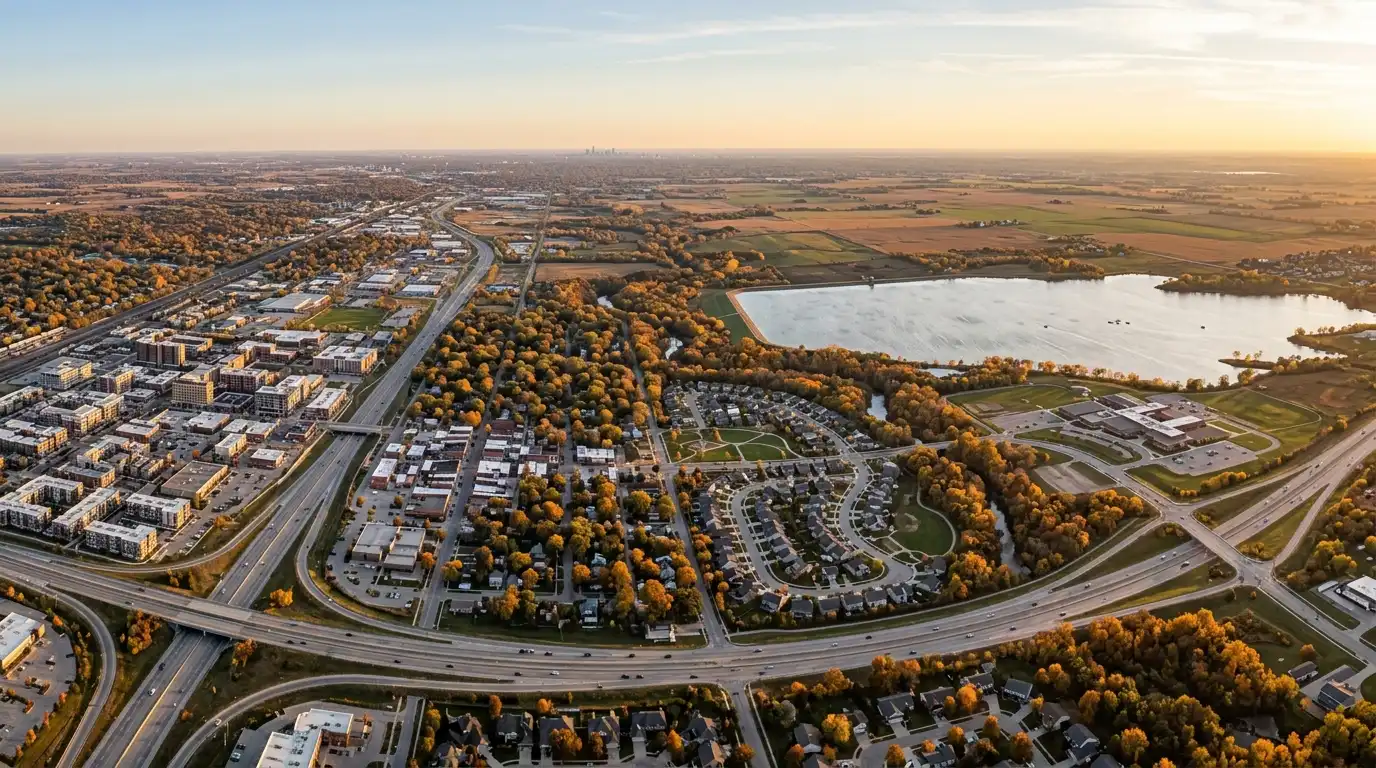
There is no single best place to live in Hamilton County for every buyer, so we do not rank one. Carmel, Westfield, Fishers and Noblesville are Hamilton County cities; Zionsville is a Boone County town. We compare them on public records, with 2026 principal-district tax rates from 2.0167 to 2.5549 per $100 of assessed value, and give structural fit tests.
We built this page from public records, not portal prices: no MIBOR price exists for any of these five towns, and structure changes more slowly than a price.
How big is each town, and which county is it in?
Four of the five are cities in Hamilton County. Zionsville is a town in Boone County, with the most land and the fewest people. Carmel and Fishers each have more than 104,000 residents on the Census Bureau’s estimate for July 1, 2025 (Vintage 2025).
| Town | County | Legal form | Land, sq mi |
|---|---|---|---|
| Carmel | Hamilton | City | 49.09 |
| Westfield | Hamilton | City | 33.68 |
| Zionsville | Boone | Town | 67.16 |
| Fishers | Hamilton | City | 38.09 |
| Noblesville | Hamilton | City | 37.60 |
Source: US Census Bureau, 2026 Gazetteer Files, Indiana places, land area on boundaries as of January 1, 2026; county from the Vintage 2025 estimates. Legal form from municipal and county records; Indiana Code 36-4-1-1 classes every municipality that is not a city as a town. Retrieved October 2, 2026.
| Town | July 1, 2025 estimate | April 1, 2020 estimates base | Change since the base | People per sq mi of land |
|---|---|---|---|---|
| Carmel | 105,634 | 99,756 | +5.9% | 2,152 |
| Westfield | 66,258 | 46,444 | +42.7% | 2,010 |
| Zionsville | 33,624 | 30,553 | +10.1% | 501 |
| Fishers | 104,812 | 99,067 | +5.8% | 2,866 |
| Noblesville | 76,111 | 69,898 | +8.9% | 2,135 |
Source: US Census Bureau, Vintage 2025 subcounty population estimates; the 2020 column is the estimates base, not a census count. Density is our arithmetic on matching January 1, 2025 boundaries (2025 Gazetteer). Boundary dates differ by source: ACS 2020-2024, January 1, 2024; Vintage 2025, January 1, 2025; 2026 Gazetteer, January 1, 2026. Westfield: a US Census Bureau special census counted 64,407 residents and 26,020 housing units on September 15, 2025, a different date, not a measure of growth or decline. Retrieved October 2, 2026.
Zionsville holds about 500 people per square mile of land, on the January 1, 2025 boundaries the population estimate uses; the other four run from about 2,010 to 2,866. Most of its size comes from consolidation: the Town’s plan says its consolidations, the Eagle and Union reorganization that took effect in 2010 and the Perry Township merger that took effect January 1, 2015, took it from approximately 10 square miles to more than 67.
How do property tax rates compare across the five towns?
On the principal district’s certified gross rate for taxes payable 2026, the five run from 2.0167 per $100 of assessed value in Carmel to 2.5549 in Noblesville. The bigger difference is structural: only Westfield has one district carrying its municipal levy, and in Zionsville and Noblesville the school corporation changes with the district.
| Town | Principal district | 2026 rate | Districts carrying the town’s levy | School corporations in those districts |
|---|---|---|---|---|
| Carmel | Hamilton 018, Carmel | 2.0167 | 3: 2.0167 to 2.4068 | Carmel Clay; Westfield-Washington in 031 only (one parcel) |
| Westfield | Hamilton 015, Westfield | 2.3448 | 1: 2.3448 | Westfield-Washington |
| Zionsville | Boone 006, 029 and 034 (identical) | 2.0336 | 7: 1.3663 to 2.0336 | Zionsville Community; Lebanon Community in 013 and 031 |
| Fishers | Hamilton 006, Fishers | 2.1994 | 2: 2.1684 to 2.1994 | Hamilton Southeastern |
| Noblesville | Hamilton 013, Noblesville City | 2.5549 | 4: 2.4503 to 2.5549 | Noblesville in 013; Hamilton Southeastern in 019, 021 and 022 |
Source: Indiana Department of Local Government Finance, 2026 Certified Tax Rates by Taxing District and by District and Unit. Gross rates before deductions, credits and the circuit breaker caps. This is general information, not tax or legal advice; confirm a parcel with the county auditor or assessor and a licensed Indiana tax professional. Retrieved October 2, 2026.
Inside Carmel the district is almost always 018: 38,293 parcels, against 93 in 023, which has the same rate, and one in 031 (Hamilton County parcel records, export of October 1, 2026). Most Westfield parcels are billed in 015, but county records also code some city parcels to a district the Hamilton County Auditor labels “Westfield Ag Abatement (100% Corp. Abated)” and a few to the unincorporated township district, so check the parcel’s own record.
Carmel’s school corporation levy in district 018 is 0.8425, against 1.1476 to 1.3000 in the other four principal districts; Zionsville’s town levy, 0.4881, is the smallest municipal levy among the five principal districts and Noblesville’s city levy, 0.9758, the largest.
None of these rates is a bill. IC 6-1.1-20.6-7.5 caps property tax liability at 1 percent of gross assessed value for a homestead, 2 percent for other residential property, long-term care property and agricultural land, and 3 percent for other real and personal property; voter-approved referendum taxes are outside the cap (section 7.5(b)). For taxes first due in 2026 or later, IC 6-1.1-20.6-7.7 adds a supplemental homestead credit of the lesser of one-tenth of the homestead’s property tax liability or $300, not counting referendum taxes, applied by the county auditor without an application. Our Senate Bill 1 guide explains how the homestead deductions are changing; Carmel vs Zionsville runs this comparison for two towns.
What kind of housing does each town have?
Zionsville’s housing is the most heavily single-family detached, 83.9 percent of units, and Carmel has the largest share in buildings of five or more units, 20.8 percent. Westfield alone has a built-2020-or-later share that stands clearly apart, 12.9 percent in the 2020-2024 survey.
| Town | Single-family detached | 5 or more units | Built 2020 or later (2020-2024 survey) | Owner-occupied share |
|---|---|---|---|---|
| Carmel | 69.9% (±1.2) | 20.8% (±1.8) | 3.8% (±0.8) | 74.3% (±1.3) |
| Westfield | 77.8% (±2.1) | 10.1% (±2.3) | 12.9% (±1.9) | 79.5% (±2.6) |
| Zionsville | 83.9% (±1.8) | 9.8% (±2.4) | 4.8% (±1.5) | 84.2% (±2.3) |
| Fishers | 76.2% (±1.4) | 15.6% (±1.9) | 3.2% (±1.1) | 76.2% (±1.9) |
| Noblesville | 71.9% (±1.5) | 17.1% (±2.3) | 3.7% (±1.0) | 71.2% (±1.6) |
Source: US Census Bureau, American Community Survey 2020-2024 five-year estimates, January 1, 2024 geography, Tables B25024, B25034 and B25003; shares are our arithmetic, owner-occupied as a share of occupied units. Margins of error at the 90 percent level; those on shares are approximations by the Census Bureau’s formula for proportions. Homes finished in 2025 and 2026 are not included. Retrieved October 2, 2026.
Both headline gaps hold up against the margins of error. The other four towns’ built-2020-or-later shares, 3.2 to 4.8 percent, overlap within their margins, so the survey does not show any of them building more than another; for volume, see the permits below.
How long is the commute from each town?
On the ACS 2020-2024 estimates, mean travel time to work runs from 22.7 minutes in Zionsville to 26.7 in Fishers; Zionsville’s is statistically shorter than each of the other four.
| Town | Minutes | Margin of error |
|---|---|---|
| Carmel | 24.6 | ±1.0 |
| Westfield | 25.1 | ±1.4 |
| Zionsville | 22.7 | ±1.2 |
| Fishers | 26.7 | ±0.9 |
| Noblesville | 26.6 | ±1.2 |
Source: US Census Bureau, American Community Survey 2020-2024 five-year estimates, Table DP03, January 1, 2024 geography. Workers 16 and over who did not work from home, all destinations and modes; margins of error at the 90 percent level. Retrieved October 2, 2026.
It is not a drive time; it is the average one-way trip of each town’s workers to wherever they work. On the Census Bureau’s 90 percent test, Carmel is shorter than Fishers and Noblesville. These pairs are not statistically different and should not be ranked: Carmel and Westfield, Westfield and Fishers, Westfield and Noblesville, and Fishers and Noblesville.
How much new housing is each town permitting?
The Westfield and Noblesville permit offices each authorized more than 1,200 new units in 2025 and again from January to August 2026. Zionsville’s authorized 234 and then 181, all in one-unit buildings.
| Permit office | 2025 total | 2025, 1-unit | 2025, 5 or more units | January to August 2026 total |
|---|---|---|---|---|
| Carmel | 514 | 339 | 175 | 764 |
| Westfield | 1,681 | 1,242 | 405 | 1,386 |
| Zionsville | 234 | 234 | 0 | 181 |
| Fishers | 556 | 459 | 91 | 341 |
| Noblesville | 1,252 | 755 | 471 | 1,212 |
Source: US Census Bureau, Building Permits Survey, 2025 annual file and January to August 2026 year to date, all months reported. Counts cover each permit office’s jurisdiction, not legal city limits: Carmel’s permit system also covers Clay Township and Westfield’s also covers Westfield Washington Township. 1-unit includes attached single-family; two- to four-unit buildings are not shown. Permits are authorizations, not homes built or sold. Retrieved October 2, 2026.
Of the 764 units Carmel’s office authorized from January to August 2026, 638 were in buildings of five or more units. For the contract side of a new build, see our guide to buying new construction in Indiana.
Which towns are still adding land and people?
Westfield’s population estimate rose 42.7 percent between the April 1, 2020 estimates base and July 1, 2025, the largest change of the five. The Census Bureau’s own files show three towns adding land between the 2025 and 2026 Gazetteers (January 1, 2025 to January 1, 2026 boundaries): Westfield from 32.97 to 33.68 square miles, Noblesville from 35.64 to 37.60, and Fishers up 1.53 square miles to 38.09.
Fishers says it completed its Southeast Fishers annexation, about 995 acres, on June 5, 2025, and Westfield’s council approved annexations in March and August 2026. Noblesville adopted two annexation ordinances on June 23, 2026, recorded August 6, 2026; as of October 2, 2026 the county’s tax-district map still showed that land in the township district without the city levy, so ask the Hamilton County Auditor which district and tax year apply.
How is each town governed, and what does its plan say about growth?
Four of the five are second class cities; Zionsville is a town with a mayor. Each plan names where growth should go.
| Town | Class | Council | Adopted plan and date |
|---|---|---|---|
| Carmel | Second class city (per the City) | Nine | Comprehensive Plan 2022; amended 2024 and 2026 |
| Westfield | Second class city since November 21, 2023 | Seven; nine from 2028 | Advancing Westfield, March 23, 2026 |
| Zionsville | Town, not a city, with a mayor | Seven | Uniquely Zionsville, June 15, 2026 |
| Fishers | Second class city; a city since January 1, 2015 | Nine | Fishers 2040, June 2016; amended 2021 and since |
| Noblesville | Second class city since January 1, 2016 | Nine | 2020 Comprehensive Plan, February 11, 2020 |
Sources: each municipality’s council pages, ordinances, resolutions and plan documents; Fishers Code of Ordinances section 30.03 and Indiana Code 36-4-6-3; City of Noblesville 2016 annual financial report. Council terms are four years in all five. Councils of nine have six members elected by district and three at large; councils of seven have five by district and two at large. Carmel adopted its plan effective December 5, 2022. Fishers is second class under the statute its own code cites. Retrieved October 2, 2026.
- Carmel’s plan: the city will “grow up, not out,” and the US 31 corridor has “significant room to grow through infill and redevelopment.”
- Westfield’s plan: “mixed-use trail-oriented development (TrOD) nodes along the Monon and Midland Trace Trails.”
- Zionsville’s plan: “Strategically manage the pace of residential development,” send higher density residential development “to activity centers along key corridors,” and preserve two named rural areas.
- Fishers’ plan: “The amount of land left for greenfield development is shrinking,” and “Redevelopment will intensify.”
- Noblesville’s plan: “Focus on infill and redevelopment for short term growth,” with expansion “within southeastern portions of Wayne Township” (Action Step 35); a rewrite, All In Noblesville, launched June 2, 2026.
Does a mailing address tell you which town you are in?
No. In all five, the city on an address can differ from the government that taxes and serves the parcel, and the school corporation can differ with it.
- Carmel: 3,157 parcels with a Carmel property address lie inside the City of Westfield, in districts that levy for Westfield-Washington Schools, and 859 parcels inside Carmel carry a Zionsville property address (Hamilton County parcel records, export of October 1, 2026).
- Westfield: in Hamilton County’s 911 address-point layer, 624 points with a Westfield postal community lie outside any city; address points include units and non-residential addresses, so they are not a count of homes.
- Zionsville: in the Census Bureau’s 2020 ZIP code tabulation areas, only 59.6 percent of the Town’s land is in ZCTA 46077, and about a tenth of 46077’s land is outside the Town.
- Fishers: the City says some properties with Fishers addresses are unincorporated, that annexation does not change a mailing address, and that its Map Fishers viewer shows city limits.
- Noblesville: Hamilton County lists Strawtown Koteewi Park at a Noblesville, IN 46060 address; the Census Bureau’s geocoder places it outside any incorporated place, in White River Township and Hamilton Heights School Corporation.
Never take the municipality, taxing district or school corporation from an address or a listing. Pull the parcel’s record from Hamilton or Boone County, read its certified taxing district, which tells you who levies on the parcel, and confirm school assignment with the school corporation.
What do homes sell for in Hamilton and Boone counties?
MIBOR’s August 2026 report puts the single-family median sales price at $485,625 in Hamilton County and $455,000 in Boone County. These are county-level, single-family figures; MIBOR publishes nothing for any town, and we do not derive one.
| Measure | Hamilton County | Boone County |
|---|---|---|
| Median sales price, August 2026 | $485,625 (+5.98%) | $455,000 (+8.27%) |
| Closed sales, August 2026 | 536 (-3.60%) | 119 (-2.46%) |
| Median sales price, January to August 2026 | $490,000 (+3.81%) | $415,000 (-3.49%) |
| Closed sales, January to August 2026 | 3,995 (+4.28%) | 897 (+16.95%) |
| Months supply, end of August 2026 | 1.7 | 1.9 |
Source: MIBOR REALTOR Association, Market Insights Report, August 2026, single-family residence only, Hamilton (page 17) and Boone (page 14) counties; footers read “updated 09/04/26.” Percent changes are MIBOR’s, against the same period of 2025. Retrieved October 2, 2026.
The one town-level value measure from a primary source is the ACS median owner-estimated value for 2020-2024 (Table B25077): Carmel $486,800 (±$10,332), Westfield $425,700 (±$17,028), Zionsville $587,800 (±$21,572), Fishers $391,000 (±$8,661) and Noblesville $349,700 (±$9,047). It is what owners said their homes would sell for, pooled over 2020-2024 in 2024 dollars: not a sale price, not a list price, not current, and never a pricing input.
Which north side town fits you?
It depends on four structural choices, not a ranking: density and housing form (Zionsville is the least dense, Carmel the largest share in buildings of five or more), tax structure (Westfield has one district carrying its city levy, Zionsville seven), whether you want a town still annexing (Westfield, Fishers, Noblesville), and the corridor you will use.
If you want land and low density, Zionsville stands apart: about 500 people per square mile of land on the January 1, 2025 boundaries the population estimate uses, 83.9 percent single-family detached, and an adopted plan that says the Town “intends to manage new housing development at a more measured pace.” If you want more multi-unit buildings in the mix, Carmel has 20.8 percent of its units in buildings of five or more and a plan that calls for that mix along trails and planned transit corridors. On the point estimates, Fishers, Noblesville and Westfield fall between the two.
If you want one district carrying the municipal levy and one school corporation, start with Westfield, where only district 015 carries the city levy and every district holding city parcels levies for Westfield-Washington Schools (a small number of city parcels are coded to districts without the city levy, so check the parcel), or Carmel, where nearly every parcel is in district 018 and the 93 in 023 carry the same rate. Fishers’ two districts sit 0.031 apart. Zionsville and Noblesville reward parcel-level checking: each spans two school corporations, and in Zionsville’s Rural Service District Boone County maintains the roads and the Town provides no trash service.
If you want a municipality still adding land and people, Westfield, Fishers and Noblesville each added land between the 2025 and 2026 Gazetteers and annexed in 2025 or 2026, and Westfield and Fishers zone beyond their limits across whole townships. If you want growth directed inward, Carmel’s plan sends it up rather than out and Fishers’ expects redevelopment. If you want it paced, Zionsville’s plan says so. In an annexing town, ask whether the parcel was recently annexed and which district it carries.
Choose by corridor, then check the commute data, not a promised drive time. Carmel’s plan points infill to the US 31 corridor, and Carmel Clay Parks & Recreation counts five miles of the Monon Greenway in the city. U.S. 31 roughly bisects Westfield, which also has State Road 32 and the Monon and Midland Trace trails. Zionsville’s plan names Interstate 65 and US 421 as its north-south corridors. Fishers has Interstate 69 and five miles of the Nickel Plate Trail; Noblesville has State Roads 37, 32 and 38: INDOT’s State Road 37 project is in design, on hold for value engineering per the City’s September 4, 2026 Roads Committee minutes, and the State Road 32 and State Road 38 contracts are on INDOT’s letting list.
Are you ready to compare the five on a real address?
Here is the test we would apply. Before you write an offer, can you state the parcel’s actual municipality, its county, its certified taxing district number and that district’s 2026 gross rate, and its school corporation, each confirmed against the county’s record rather than a listing? Near the White River, add a FEMA flood-map check: after the August 2026 flooding, Carmel declared a local emergency and the City of Noblesville, the State of Indiana and the federal government issued emergency declarations. If you cannot answer those, you are comparing mailing addresses, not towns. Once you can, moving to the Indianapolis north side covers the filing and closing steps.
Frequently Asked Questions
What is the best place to live in Hamilton County, Indiana?
There is no single best place for every buyer, and we do not rank one. Carmel, Westfield, Fishers and Noblesville are cities in Hamilton County; Zionsville, often compared with them, is in Boone County. They differ in measurable ways: Westfield has one taxing district carrying its city levy and Zionsville seven. Compare density and housing form, tax structure, growth and annexation, and the corridor you will use, then check the parcel.
Which north side suburb fits me?
It depends on structure, not a ranking. On the ACS 2020-2024 estimates, Zionsville, a Boone County town, has the highest single-family detached share, 83.9 percent, and Carmel the largest share in buildings of five or more, 20.8 percent. Westfield has one taxing district carrying its city levy, and Westfield, Fishers and Noblesville each added land between the 2025 and 2026 Census Gazetteers. Then compare the corridor you will use and check the parcel.
Is Zionsville in Hamilton County?
No. Zionsville is a town in Boone County, and its property is taxed in Boone County taxing districts; Carmel, Westfield, Fishers and Noblesville are cities in Hamilton County. Mailing addresses do not follow the county line: Hamilton County parcel records (export of October 1, 2026) show 859 parcels inside the City of Carmel with a Zionsville property address, all in Carmel’s taxing district 018.
Which north side town has the lowest property tax rate?
On the principal district’s certified gross rate for taxes payable 2026, Carmel’s district 018 is lowest at 2.0167 per $100 of assessed value, then Zionsville at 2.0336 in the Zionsville Corporation district and its two urban service districts (Boone 006, 029 and 034; Zionsville has no single principal district), Fishers at 2.1994, Westfield at 2.3448 and Noblesville at 2.5549. Rates vary inside towns: Zionsville’s lowest district, Perry Perry/Zionsville Rural District (013), is 1.3663, but it carries Lebanon Community School Corporation, not Zionsville Community Schools. These are gross rates before deductions, credits and caps, not bills; confirm a parcel with the county auditor or assessor.
Which north side town is growing fastest?
By population estimate, Westfield shows the largest percentage change since the April 1, 2020 estimates base: up 42.7 percent, from 46,444 to 66,258 on July 1, 2025 (Census Bureau, Vintage 2025). Zionsville rose 10.1 percent, Noblesville 8.9, Carmel 5.9 and Fishers 5.8.
How do I check which town, tax district and school corporation an address is in?
Use the county’s parcel record, not the mailing address or the listing: Hamilton County for Carmel, Westfield, Fishers and Noblesville, Boone County for Zionsville. The record gives the certified taxing district, which shows which municipality and school corporation levy on the parcel; the town name alone does not, since the districts carrying the Noblesville city levy split between Noblesville Schools and Hamilton Southeastern Schools. In Fishers, the City’s Map Fishers viewer also shows city limits. Then confirm school assignment with the school corporation.
Which north side town has the shortest commute?
On the American Community Survey’s 2020-2024 estimates, Zionsville’s mean travel time to work, 22.7 minutes plus or minus 1.2, is statistically shorter than each of the other four. Carmel’s 24.6 minutes is shorter than Fishers’ 26.7 and Noblesville’s 26.6 but not different from Westfield’s 25.1. The measure covers workers 16 and over who did not work from home, to all destinations by all modes; it is not a drive time.
Is there a median home price for each town?
Not from MIBOR REALTOR Association, which publishes nothing below county level. In August 2026 the single-family median sales price was $485,625 in Hamilton County and $455,000 in Boone County; neither describes any one town. The only town-level value figure from a primary source is the Census Bureau’s median owner-estimated value for 2020-2024, what owners said their homes would sell for: not a sale price, not a list price and not current.
Compare the towns in more depth
Compare the five on the parcels you are considering
We work across Hamilton and Boone counties. Send us the addresses you are weighing and we will pull each parcel’s municipality, certified taxing district, school corporation and comparable sales before you write an offer.